For most of its modern history, economic geography has been a discipline of the rear-view mirror. We have been very good at explaining why places get stuck. Path dependence, lock-in, the weight of inherited industries and institutions: these ideas gave us a powerful grammar for diagnosing why a coal town stays a coal town long after the seams run dry, and why prosperity keeps clustering in the same handful of metropolitan cores. The framework is elegant. It is also increasingly becoming a trap of its own.
The problem is not that path dependence is wrong. The problem is that it quietly smuggles in a fatalism. If the future is mostly an extension of the past, then the analyst’s job is to map constraints, not possibilities. We end up treating a region’s present condition as the inevitable outcome of structural forces rather than the contingent result of specific choices that real people made, and could have made differently. For the “left behind” places now living through stagnation, outmigration, and rising political resentment, a discipline that can only narrate decline risks becoming complicit in it.
So here is the question we keep returning to. If regions are not just inherited structures but socio-spatial formations actively imagined and contested by the people who live in them, why are our methods still built almost entirely for looking backwards?
A richer toolbox
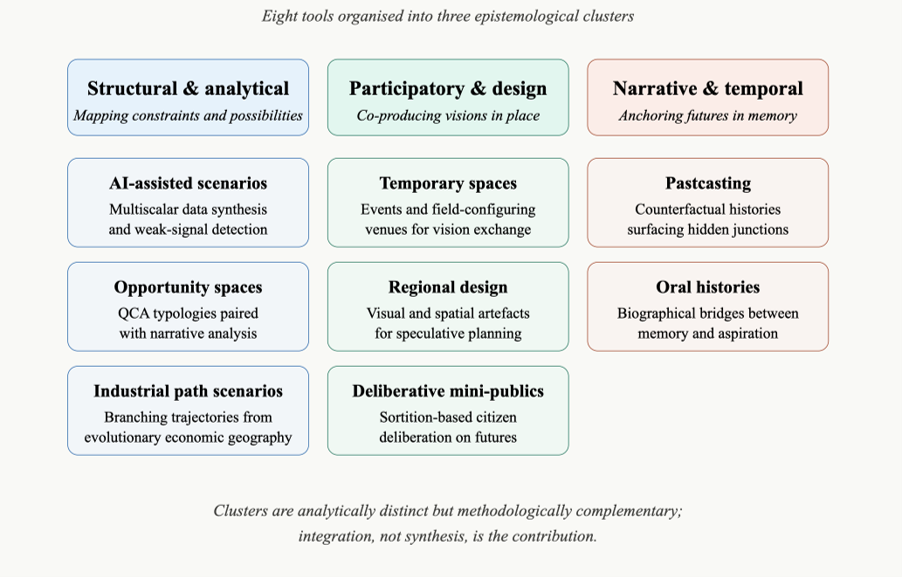
In our recent paper with Suyash Jolly, we set out to map what would a forward-looking methodological toolbox might contain. We surveyed eight tools for studying regional futures and sorted them into three families.
The first is computational: AI-assisted scenario building, the mapping of regional opportunity spaces, and future-oriented industrial path scenarios. The second is participatory and design-based: regional design workshops, deliberative mini-publics, and the temporary events where new coalitions quietly incubate. The third is narrative and memory-based: pastcasting, recasting, and the oral histories that anchor possible futures in remembered lives.
The point was never to crown a winner. Different dimensions of transformation simply require different ways of knowing. A large language model can detect weak signals across thousands of policy documents, but it cannot tell you what it feels like to watch a shipyard close. A grandmother’s account of collective farming can, and that affective knowledge shapes which futures a community will accept as legitimate. Each family of methods is strongest exactly where the others are blind.
Pluralism is not the same as democracy
Assembling a richer toolbox is the easy part. The harder and more uncomfortable argument is this: none of these methods are politically innocent, and methodological diversity does not automatically democratise anything.
Consider what happens when the tools disagree. An AI scenario engine, trained on the past data exhaust, concludes that a region’s capability structure makes a certain green industry “infeasible.” Meanwhile, a citizens’ assembly in the same region deliberates carefully and decides it wants exactly that pathway. Who wins? This is not a technical glitch to be smoothed over. It is a genuine epistemic conflict between expert-derived feasibility and community-defined aspiration, and no algorithm resolves it. Defer to the model and you encode historical patterns of marginalisation as features of the projected future. The places that have always lacked data and institutional clout get told, with the borrowed authority of computation, that their dreams are unrealistic. The future arrives already foreclosed.
The participatory methods carry their own quiet exclusions. Deliberative forums privilege citizens who have the time, the literacy, and the cultural capital to engage. Design workshops reward those fluent in the visual language of maps and models, while sidelining the person whose knowledge of a place is embodied rather than technical. We have a name for the worst version of this: participatory washing, where communities are consulted with great ceremony but elite visions prevail anyway. The performance of inclusion becomes a more sophisticated mechanism of exclusion.
Even the memory work, which I find genuinely moving, has a sharp edge. Pastcasting and oral history can liberate a community by revealing the hidden junction points where things could have gone otherwise, restoring agency to people who had come to see their decline as destiny. Or they can curdle into nostalgia, romanticising a golden age that never was and foreclosing transformation in the name of heritage.
We are not neutral instruments
What ties this together is an observation that should unsettle anyone who does this work. These methods do not merely study futures. They construct them. When a researcher decides who sits in the room, how the question is framed, which scenario gets visualised and which is left unspoken, that researcher is actively shaping which futures become thinkable at all. We are participants in the political struggle over a region’s meaning, not observers of it.
That is why I think the most important methodological question facing our field is no longer “how do we model the future more accurately?” It is older, and more honest: for whom, and by whom, is the future imagined? Until we answer that with humility and a real commitment to epistemic justice, we risk building ever more elaborate tools that simply hand the future to whoever already owns the present.
Read more about this paper: Farooq, M., & Jolly, S. (2026). Beyond path dependence: a methodological review for studying regional futures. Regional Studies, Regional Science, 13(1). https://doi.org/10.1080/21681376.2026.2686021
Connect with the Author

Muzamil Farooq is a Marie Skłodowska-Curie Doctoral Fellow at the Centre for Innovation Research, UiS Business School, University of Stavanger, affiliated with the EU-funded SUNSET Doctoral Network on sustainability transitions in European regional contexts. His research sits at the intersection of economic geography and innovation studies, focusing on regional imaginaries and the politics of sustainability transitions. He hosts the weekly The RegInno Podcast.

 :
: