Why do some regions recover from violent conflict more slowly than others? And how long do the economic effects of conflict persist across space? These questions remain central to regional development research, especially in places where war has reshaped long-run economic activity (Abadie and Gardeazabal, 2003; Blattman and Miguel, 2010). Looking into this question, Kešeljević, Spurk, and I recently published a paper in the Journal of Regional Science, which examines these issues using region-level evidence from the former Yugoslavia.
The breakup of Yugoslavia in the 1990s led to ethnic conflict and civil war on a devastating scale. It also provides an important case for understanding how conflict affects regional development. Rather than treating war as a national shock with uniform effects, our paper asks how conflict shaped economic outcomes differently across regions. Looking below the national level reveals how war can produce uneven development trajectories that persist long after the violence has ended.
In our study, we analyse GDP per person for 78 regions across five former Yugoslav republics, covering the period from 1950 to 2015. To estimate what these regional economies might have looked like in the absence of war, we compare them with similar regions in 32 countries that did not experience conflict. This approach allows us to trace the long-run economic effects of war while taking account of differences in regional development paths over time.
What did we find?
We found three main results.
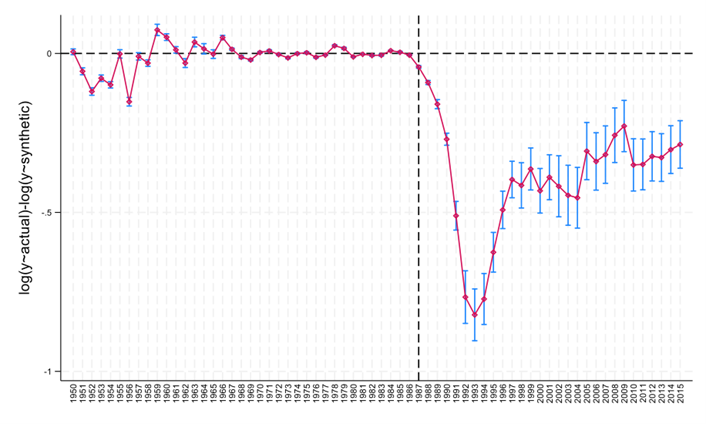
- First, the Yugoslav civil war caused extremely large and lasting economic damage (Figure 1). On average, GDP per person in affected regions was 38% lower than it would likely have been without the war. In the hardest-hit regions, the losses reached as much as 79%. Even by 2015, there was no clear evidence of long-run recovery.
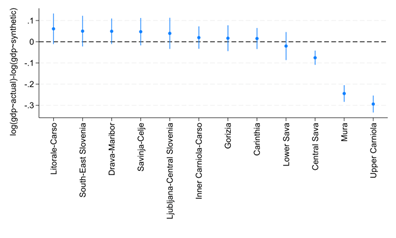
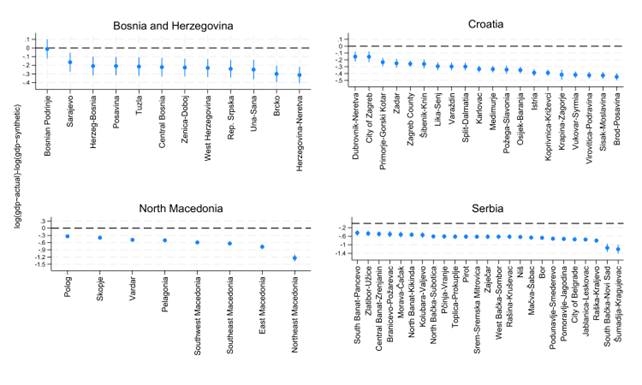
- Second, the effects varied sharply across regions. North-western regions, which were closer to Western Europe, tended to perform better after the war and experienced more temporary losses (Figure 2). By contrast, many south-eastern regions, especially in present-day Bosnia-Herzegovina, Serbia, and North Macedonia, suffered much deeper and more lasting economic decline (Figure 3). Capital city regions were also generally more resilient than surrounding areas.
- Third, we explain why these regional differences emerged. Larger GDP losses were associated with population displacement, ethnic division, and greater distance from Western Europe. The contribution of the paper, then, is not only to show that war harms growth, but also to identify some of the factors that help explain why some regions recovered more successfully than others.
Policy Implications
These findings have broader policy implications. Post-conflict reconstruction is often framed in national terms, but our evidence suggests that recovery needs to be understood spatially. If conflict outcomes differ across regions, policy responses should do the same. A uniform national strategy may miss the places where humanitarian support, ethnic reconciliation, and improved market access are most urgently needed. Post-conflict growth depends both on macroeconomic stabilisation and on how effectively recovery strategies address regional damage and division.
The former Yugoslav case remains especially relevant today because many regions around the world continue to face the long shadows of conflict, political fragmentation, and uneven development. Understanding these legacies matters not only for interpreting the region’s economic geography but also for thinking more broadly about how civil war reshapes regions elsewhere.
Read more about this research here: Kešeljević, A., S.Nikolić, and R.Spruk. 2026. “Ethnic Conflicts, Civil War, and Economic Growth: Region-Level Evidence From Former Yugoslavia.” Journal of Regional Science 0: 1–28. https://doi.org/10.1111/jors.70055.
Connect with the Author

Dr Stefan Nikolic is a Lecturer in Economics at Loughborough University with expertise in applied economics and economic history. His research examines spatial inequalities in economic performance. He combines historical data and economic methods to explore why some areas are more economically developed than others. His research focuses on central and south-eastern Europe. He has published in The Journal of Economic History, The Economic History Review, Explorations in Economic History, European Review of Economic History, Journal of Regional Science, and Journal of Development Economics.
 : stefan-nikolić
 :
:  :
: