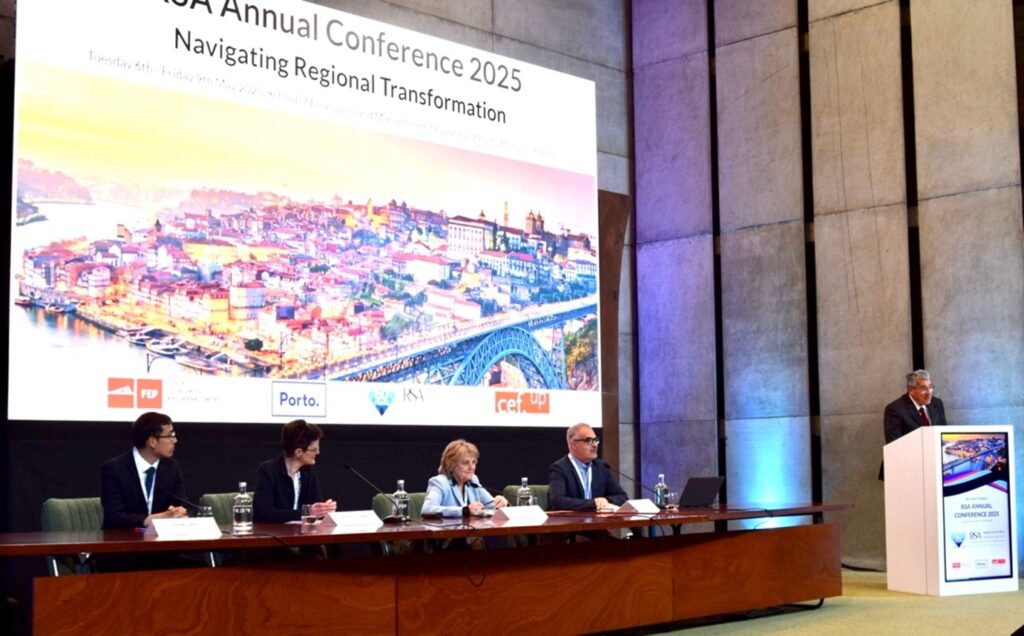
One moment in 2025 has felt like a rare stroke of cosmic luck. In May, I was honoured to serve as the Early Career Plenary Speaker at the opening session of the Regional Studies Association (RSA) Annual Conference. Delivering the keynote alongside high-profile academics – Professor Elisa Ferreira (former European Commissioner for Cohesion and Reforms), Mr. Pedro Conceição (Director of Human Development Report Office, UNDP), Professor Michaela Trippl (University of Vienna, FAcSS, FeRSA), and Professor Mário Vale (former President of the Portuguese Association of Geographers, FeRSA) – was an unforgettable experience. As someone just stepping into the academic career, this recognition means more than I can say.
I began my PhD during the COVID-19 pandemic, a time when screens replaced lecture theatres, face-to-face interactions were limited, and many feared a declining educational quality. Looking back now, I was extremely fortunate to be supervised by Dr. Davide Luca. In fact, he had joined our department as an assistant professor only a few months before my arrival, and I naturally became his first PhD student. However, he was definitely far from a novice PhD supervisor; by sheer contrast, I benefited greatly from his full attention as his sole PhD student during my first two years, until Qiumeng Li and Murray Fallk joined us consecutively.

My PhD research focuses on “spatial inequality,” yet I cannot clearly recall when this concept first took root in my mind. In retrospect, however, I suspect that my earliest understanding of it stems from my own upbringing. I was raised by my elderly, amiable, and illiterate grandparents in a small rural village in southeastern China, where I attended local primary and junior high schools before being selected to a prestigious senior high school in the city. The stark rural–urban divide in educational resources, economic facilities, and infrastructure had very early made me feel that there must be something we can do to build a more geographically equitable world, one in which individuals, regardless of their origins, have more equal access to opportunities and can share in the benefits of socioeconomic prosperity.
Under the theme of spatial inequality, my PhD research encompasses four distinct aspects across four different contexts: how the uneven distribution of remote work during the pandemic across regions has reshaped regional development trajectories in Europe; how exposure to urban environments during impressionable years influences long-term values in Switzerland; how political polarization manifests in regional housing markets in the context of Brexit; and how local wealth inequality fuels political protests across the Global South. They were structured as four essays in my dissertation, and at first glance, they may appear multifaceted and, admittedly, somewhat loosely connected. In fact, my shaky and incoherent first-year report was ever required by the examiners to undergo extensive revisions!
But gradually, I realized that this unconstrained exploration around a common theme converged on a clear research direction that I found truly fascinating: applying geospatial artificial intelligence (GeoAI), GIS, big data, and causal inference methods to understand the causes and consequences of spatial inequality. Exemplified by the chapters in my dissertation, this research agenda is underpinned by four key features that I want to highlight below.
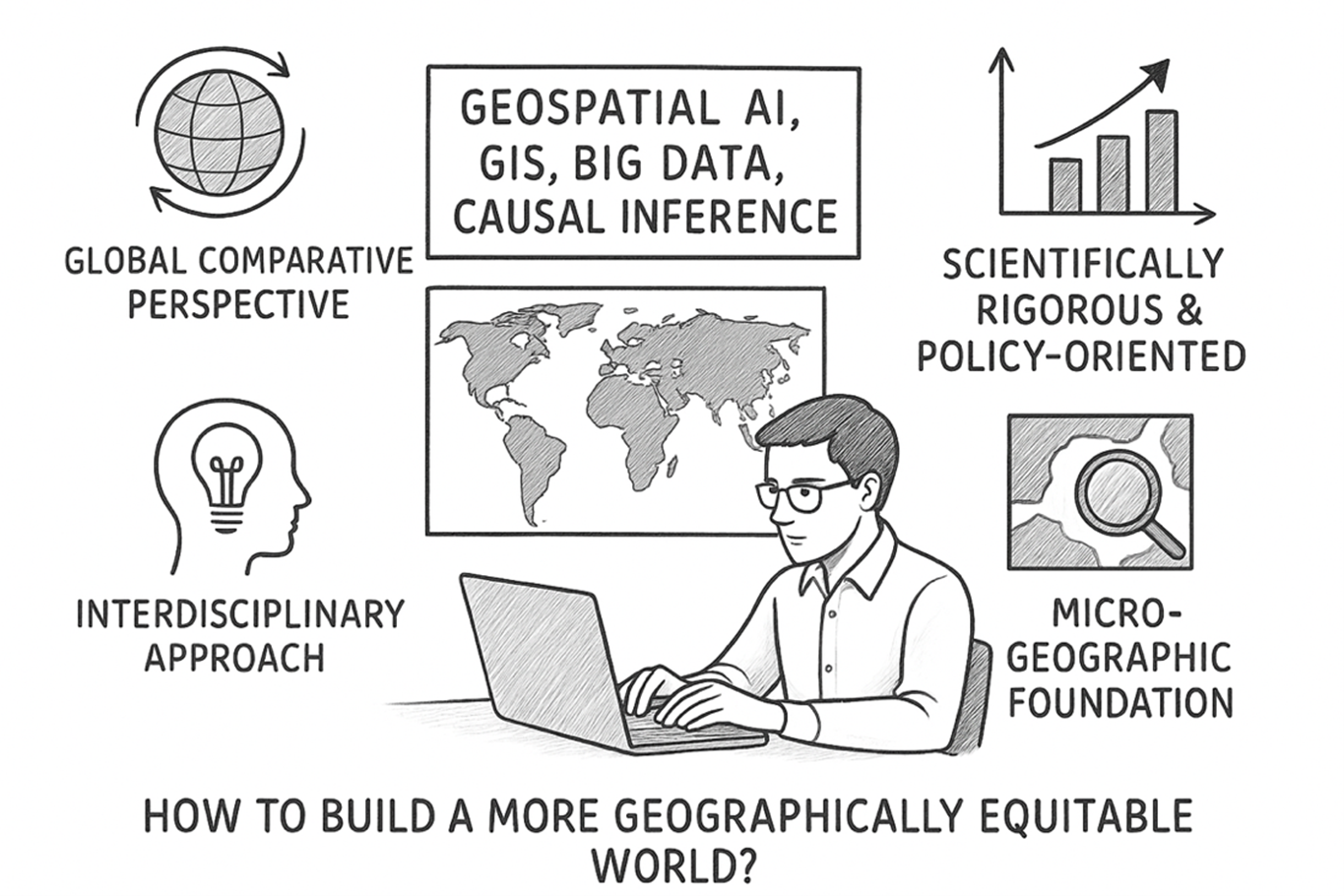
- It embraces a global comparative perspective, examining regions across both the Global North and South. This allows to identify both common and context-specific roots of spatial inequality, and to develop a more holistic understanding of localization within globalization.
- It aims to be both scientifically rigorous and policy-oriented, generating evidence that can inform decision-making and practice.
- It adopts an interdisciplinary approach that spans geography, economics, political science, psychology, and beyond. Quite often, I would try to convince potential coauthors from completely different disciplines that the originality and novel fields of the future will emerge at the intersections of diverse disciplines today. And it often works.
- It aims to build a micro-geographic foundation for contemporary political and economic phenomena. Thanks to the rapid expansion of geospatial big data and advances in GIS and GeoAI, measuring economic and social structures at very fine spatial scales, once highly challenging, is now increasingly feasible, providing valuable insights into complex social science puzzles.
The combination of these features appears promising, as it allows many spatial inequality issues to be addressed more systematically and convincingly, while informing the design of corresponding policy solutions.
Finally, I was fortunate to have my PhD dissertation passed without corrections in a viva by Professor Philip McCann and Professor Maria Abreu, and it was later awarded the Regional Science Association International (RSAI) Dissertation Award – a well-established international prize in regional economics – for work that the selecting committee described as “an extremely high-quality, relevant, and impactful contribution” addressing “one of the most pressing issues in contemporary Regional Science”. In particular, the chapter on the link between local wealth inequality and political protests across the Global South contributed to my selection as the Early Career Plenary Speaker at the RSA Annual Conference. And I was also awarded a prestigious Leverhulme Early Career Fellowship, which offers me my current position and allows me to lead a postdoctoral project on spatial inequality as the principal investigator.
These achievements throughout my PhD journey and in my early career so far are, of course, the product of joint work. Beyond Davide, I owe my gratitude to Professor Andrés Rodríguez-Pose, Professor Jane Gingrich, Dr. Cem Özgüzel, Dr. Pei Kuang, Dr. Yohan Iddawela and many others with whom I had the privilege to think, work, and interact together.
And last but not least, I must say that joining the RSA community has been one of the highlights of my academic career. Therefore, I owe special appreciations to my co-author Professor Neil Lee who was then Chair of the RSA and introduced me to join this community at the 2024 Winter Conference. I am also deeply grateful to the current RSA Chair, Professor Sarah Ayres, who sat with me before my Early Career Plenary Speech to offer support and was the first to congratulate me on a job well done afterward. I also appreciate her invitation to write this blog, which has allowed me to reflect on my PhD experiences and think about what I should continue to strive for in the near future. I look forward to the many more stories that lie ahead in my journey with the RSA.
Connect with the Author

Zhiwu Wei is Leverhulme Trust and Isaac Newton Trust Early Career Fellow at the Department of Land Economy, and Governing Body Fellow of Hughes Hall, University of Cambridge. He is also a Visiting Fellow in the Department of Social Policy and Intervention at the University of Oxford, and affiliated with Cambridge’s Lab of Interdisciplinary Spatial Analysis. He served as the Early Career Plenary Speaker at the opening session of the 2025 Regional Studies Association (RSA) Annual Conference, and is the winner of the 2025 Regional Science Association International (RSAI) Dissertation Award.
 :
:  :
: