The RSA Research Network on Financial Geographies has operated with RSA support under the auspices of the Global Network on Financial Geography (FinGeo). Since its launch in 2015, FinGeo has grown into a major global player with more than 600 members in over 50 countries spanning all continents. The Network has brought together geographers, economists, sociologists, political scientists, scholars in urban and regional studies, business studies, international relations and finance, and others. While our members mostly work in universities and research institutes, there are also FinGeo members working in government organisations, international organisations, NGOs, non-academic research firms and private sectors. The growing membership reflects an interest in our mission as being an open interdisciplinary network of academics, practitioners and experts interested in research on the spatiality of money and finance, and its implications for the economy, society and environment.
The RSA Research Network on Financial Geographies (FinGeo) aims to develop its global network of researchers to the next level as it fosters cutting-edge research on financial geographies, which are critical to regional studies. Building on the strengths of our previous successful RSA Research Networks (Geographies of Finance and Post-Socialist Transformations Research Network, 2010-2013; Research Network on Financial Geographies 2015-2018), FinGeo aims to continue expanding our Network membership globally beyond Europe, focus more attention on providing training and support for Early Career Researchers (ECRs) and strengthen engagement with non-academic participants (e.g. industry practitioners, NGOs, policy makers). These will foster global comparisons of the complex relationships among finance and regions, and enrich contemporary debates by facilitating exchanges of views of researchers and practitioners from different backgrounds, career stages and academic traditions. Such a truly global Research Network will enrich regional studies and contribute to policy debates through high-quality research outputs and engagement with stakeholders.
In recent years, FinGeo has held seminars and workshops in different parts of the world, including Frankfurt, Boston, Singapore, Sao Paulo, and Brisbane. In June 2018, FinGeo held its first Spring School in Brussels to train and support ECRs. In September 2019, the 1st FinGeo Global Conference was held in Beijing with over 120 international participants and more than 90 presentations.
With an extension of the funding, the Research Network will work towards the following key areas: growing membership, grooming ECRs, developing links with non-academic members, and dissemination of research and outputs. FinGeo will continue a strategy of promoting a broad, diverse, interdisciplinary and inclusive approach to financial geography. Nevertheless, two large research areas in which we plan to be particularly visible and make an impact concern sustainable finance and financial technology in cities and regions.
FinGeo website: http://www.fingeo.net/
Facebook: https://www.facebook.com/fingeonet/
Twitter: https://twitter.com/fingeonet
Future Events
Call for Submissions: 2026 FinGeo Doctoral Dissertation Prize
Deadline: 30 September 2026
We are delighted to open submissions for the 2026 FinGeo Doctoral Dissertation Prize, celebrating outstanding early-career research at the intersection of finance and space. If your dissertation makes a compelling contribution to financial geography, we would love to hear from you.
Eligibility: Dissertations completed between 1 January 2025 and 31 March 2026 are eligible. We welcome submissions from any discipline, provided they centre on the relationship between finance and space and make a clear contribution to debates in financial geography.
Language and review process: The prize is assessed in two stages. In the first stage, all applicants submit materials in English for initial screening, ensuring consistency and fairness across the judging panel. Applicants whose dissertations were written in another language may use translation tools to prepare these materials. Only shortlisted applicants will proceed to the second stage and be asked to submit the full dissertation, which may be submitted in its original language.
Initial submission (Stage 1): Please submit an extended abstract in English of no more than 1,500 words, a reference list in English, a table of contents in English, and a note stating the dissertation’s original language.
Assessment criteria: The initial submission will be assessed for originality, methodological soundness, novelty, empirical rigour, and style.
Prize: The winner will be recognised by FinGeo, receive a €500 award, and be invited to share their research with the FinGeo community through a short blog post on the FinGeo website.
How to submit: Please email your initial submission, or any questions, to Paweł Węgrzyn at pwegrz@sgh.waw.pl.
Past events
2026 RSA Annual Conference
17 June, 14:00 CEST
The Global Network on Financial Geography (FinGeo) Workshop
Financial Geography in Central Asia: Towards a Research Agenda for Regional Development and Financial Integration
📅 19 May 2026
🕓 16:00–18:00 (GMT+5)
🌍 Online
Central Asia is undergoing significant economic and institutional transformation, shaped by financial sector reforms, increasing regional connectivity, and deeper integration into global production and financial networks. Recent developments, including rising foreign direct investment, expanding infrastructure finance, and the region’s growing importance within transnational economic corridors, are beginning to alter patterns of economic activity. At the same time, new financial centres are emerging, signalling a stronger emphasis on finance within broader strategies of economic diversification and regional integration.
Despite these developments, Central Asia has received relatively limited attention in the financial geography literature, particularly in work on the spatial organisation of financial systems, the territorial embedding of financial institutions, and uneven patterns of financial development. Research in financial geography has shown how financial networks and institutions are shaped by place-specific conditions and how they contribute to processes of regional development and economic restructuring. Much of this work, however, has focused on advanced and selected emerging economies, with less attention paid to Central Asia.
This creates an opportunity to extend existing debates and to engage more directly with questions of financial development, institutional change, and spatial inequality in post-socialist and emerging regional contexts.
In this context, the online workshop organised by the Global Network on Financial Geography (FinGeo) aims to bring together scholars working on Central Asia alongside researchers in financial geography to exchange ideas and develop a research agenda for the region. The workshop seeks to identify key analytical perspectives, encourage interdisciplinary dialogue, and support the development of ongoing collaboration, including potential future FinGeo activities in Central Asia.
Workshop Program
- Workshop Welcome and Opening Remarks:
Alena Dolgova, International expert on the creation and development of International Financial Centres - Introduction to the FinGeo Network:
Franziska Sohns, Chair, Global Network on Financial Geography (FinGeo): Introduction to the FinGeo community, its research agenda, and current initiatives. - Introduction to Financial Geography as a Field:
Dariusz Wójcik, Provost’s Chair Professor of Financial Geography, National University of Singapore; Honorary Research Associate, University of Oxford: Overview of the main research themes, conceptual approaches, and the development of financial geography as a field of study. - Research Presentations:
Short research presentations by invited scholars working on financial geography and Central Asia. - Mapping the Research Agenda for Financial Geography in Central Asia:
This interactive session will bring together invited commentators and open-floor contributions to identify key research priorities for financial geography in Central Asia. - FinGeo Initiative in Central Asia:
Franziska Sohns & Alena Dolgova: Presentation on the concept of a FinGeo School / Regional Seminar in Central Asia 2027. - Moderator: Alena Dolgova, International Expert on on the creation of an International Financial Centre
Researchers, students, and practitioners interested in financial geography and regional development in Central Asia are warmly invited to attend.
4th FinGeo School in Bologna (31st January and 1st February 2026) – A truly international winter school!
The 4th edition of the FinGeo School was successfully held in Bologna at the Italian Yunus Foundation, with the support of the Regional Studies Association. With 40 participants from all over the world and an international scientific committee, the School was truly global, friendly, and insightful, in full FinGeo tradition.
The core focus of this edition was to explore and experiment with a wide range of field research approaches for data collection and analysis in financial geography.
A distinctive feature of the School was the frequent practice of walking, following the motto of the 4th FinGeo School, “Geography is learned and researched by walking”. This motto, traditionally attributed by academic geographers at the University of Bologna to Prof. Mario Ortolani (1909-1998) , reflects the belief that geographical knowledge is not acquired solely through books, but through direct observation, fieldwork, and first-hand experience of places. Reflections during the School also highlighted how this approach is likely to become increasingly strategic as AI continues to grow.
Thanks to the Scientific Committee, the programme included six lectures covering field research methods (Stefanos Ioannou, Yllka Hysay); semiotic and visual methodologies (Silvia Grandi, Fenghua Pan, Alessandro Serravalli); participant observation and ethnographic methods (Karen Lai); spatial econometrics (Carmelo Algeri, Giuseppe Torluccio); and issues in collecting data in the Global South (Juvaria Jafri, Claudia Affonso). The programme also featured a roundtable discussion on how and where to publish, moderated by the FinGeo Chair, Franziska Sohns. Lot of attention has given to FinViz and the publication opportunities in Finance & Space of this novelty, hence the project work of the FinGeo School teams.
Moreover, two field lectures were also conducted: one based on a semiotic approach led by Silvia Grandi, combined with a technological GIS-based approach led by Alessandro Serravalli discovering and mapping the sign of the Bologna Financial District; and another held at the Museum of Industrial Heritage, offering a deep dive into the history and contemporaneity of Bologna’s industrial, economic, and financial system.
The School also provided valuable opportunities for informal exchange, with lively evening discussions and networking lunches.
FinGeo is working already on the 2027 edition, Keep posted!
Links to read more and visualize more:
The 8th FinGeo Seminar
8th FinGeo International Seminar at the University of Bologna (2nd and 3rd February 2026): A Global Community Advancing Contemporary Financial Geography
The international FinGeo Seminar, preceded by the FinGeo School, has concluded, bringing together a broad and diverse scholarly community to discuss key contemporary advances in financial geography.
The event featured 33 paper presentations across six parallel sessions and 22 contributions in plenary sessions, enriched by the participation of six high-level representatives from national and European institutions, as well as research, financial, and consultancy organizations, including Federcasse, UBS, and STS Deloitte. The initiative involved participants from around 30 different nationalities and more than 40 scientific institutions, confirming the truly global scope of the FinGeo network.
Discussions highlighted a discipline that is vibrant, interdisciplinary, and methodologically diverse, capable of addressing the complexities of the contemporary world through quantitative, qualitative, and theoretical approaches. The seminar addressed a wide range of interconnected themes, from finance and development and social business to environmental sustainability, technological innovation, urban development and real estate, as well as geopolitics, geoeconomics, and geofinance. Together, these discussions reaffirmed the strategic role of financial geography in interpreting the evolving relationships between finance, society, and the environment.
The Seminar was made possible thanks to the financial and logistical support of the Department of Management of the University of Bologna, the Italian Yunus Foundation, and the Regional Studies Association.
The event also confirmed the friendly and open environment that characterizes the FinGeo tradition. Looking ahead, and thanks to the renewed funding of the FinGeo network for the next three years, the community will reconvene next year in a similar format. Participants were also invited to continue the dialogue through paper submissions and FinViz contributions in Finance and Space, further strengthening collaboration within the FinGeo network.
Programme, book of abstract and material: https://www.fingeo.net/post/8th-fingeo-international-seminar-contemporary-advances-in-financial-geography
Links to read more and visualize more:
RSA Annual Conference Fingeo Plenary: Financial Centre Networks: From Florence to Sustainable Finance
13th June 2024, Florence, Italy
Speakers: Youssef Cassis, Robert Schuman Centre for Advanced Studies / European University Institute
Silvia Grandi, University of Bologna, Italy
2nd- 3rd March 2024, Beijing Normal University, China
Special Session at RSA Annual Conference, June 2023
This RSA FinGeo Research Network plenary session formed part of the launch of the new journal ‘Finance & Space’ (a collaboration between RSA and FinGeo). The plenary addressed the conference theme on ‘Transforming Regions: Policies and Planning for People and Places’ by highlighting the potential and challenges of economic transformation and socio-economic and political impacts as we transition to a post-Covid world and with net-zero targets dominating academic and public policy debates. The event was attended by approximately 150 people from more than 30 countries.
The FinGeo plenary session contributes to the network’s objective of promoting a broad, diverse, interdisciplinary and inclusive approach to financial geography. The title of the plenary ‘Sustainable Financing and Unsustainable Debt’ addressed one of three specific research areas highlighted by the network in the current period of funding, namely ‘sustainable finance and climate change’.
The plenary session, featuring three distinguished experts in conversation and employing examples from around the world:
- Katherine Brickell (King’s College London, UK) and Vincent Guermond (Royal Holloway London, UK) – Microfinance, over-indebtedness and climate adaptation: New evidence from rural Cambodia.
- Daniela Gabor (UWE Bristol, UK) – The green derisking state.
- Chaired by Sabine Dörry (Luxembourg Institute of Socio-Economic Research, Luxembourg)
The plenary addressed the following questions:
- How can we ‘shrink’ finance and turn too much (bad) debt turn into finance for social good?
- How can we tackle household over-indebtedness together with the climate crisis and the negative impacts these are both having on people’s and places’ health and well-being?
- How can we redesign and redefine (financial) relationships between places that (re)produce inequalities in resources, power and wealth?
The first set of speakers, Katherine Brickell and Vincent Guermond, presented research findings from recent projects in Cambodia and India that examines climate resilience, small scale credit and household outcomes. In their critique of developmental discourses around green microfinance and financial inclusion, they demonstrate the harmful strategies taken by households in Cambodia to ensure repayment of loans, ranging from further borrowing (and indebtedness) to selling assets and giving up on farming entirely. All of these point to increased economic precarity as agricultural livelihoods and indebtedness become more unstable in the context of climate change. The second speaker, Daniela Gabor, provided a macroeconomic perspective on how the state is shaping decarbonisation and green economic transition, by creating investible opportunities for private capital such as public-private partnerships in green projects and Green Industrial Plans to encourage developments in renewable energy and hydrogen markets. Drawing from examples from the USA and Europe, she point to a growing relationship between central banks, governments and private capital that focuses on incentivising investments away from ‘dirty’ sectors to ‘green’ sectors. However, she cautions against this outsourcing of green transition to private capital as this could lead to systemic greenwashing and there are distributional outcomes with the privatisation of public infrastructure. After the presentations, Sabine Dörry chaired the Q&A discussion, during which speakers and participants reflect on how these different modalities of addressing climate change challenges involve different scales and agencies of state actors and the uneven impacts of debt relating to gender and different Global South contexts.
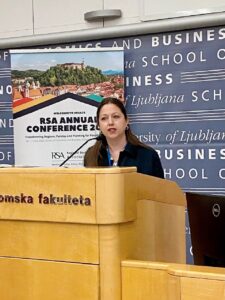
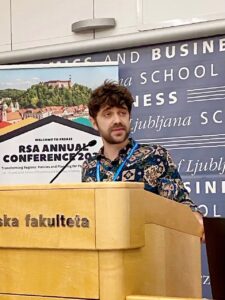
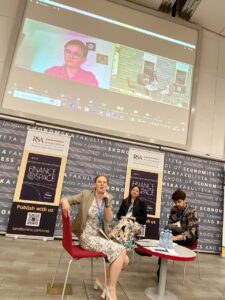
FinGeo supported the 2023 RSA Annual Conference partners and supporters.
Click the link to view past seminars in the RSA FinGeo Virtual Seminar Series.
Plans for future events
- Conference on intersections of global production and financial networks, China, Nov 2023
- Spring/Summer School, Cape Town, mid 2024
- Workshop, London, Summer 2024
- Special Session at RSA Winter conference 2024 or 25
- Seminar, Italy, mid 2025