Innovation policy is often designed as if geography does not matter. Public agencies often allocate public financial aid to innovative firms based on project quality and firm characteristics, but rarely investigate whether the location of those firms shapes how much they benefit. Our recent research suggests it should.
In our recent publication in Industrial and Corporate Change, we examined the impact of subsidized loans provided by Bpifrance, France’s public investment bank, on the productivity and innovativeness of small and medium-sized enterprises (SMEs). Using a unique firm-level dataset covering the period 2011–2016, and combining propensity score matching with a staggered difference-in-differences estimator, we show that this policy instrument generates positive effects on average, but that these effects are strongly conditioned by pre-existing regional characteristics.
The policy and the data
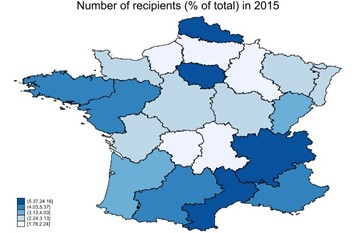
We investigate Bpifrance’s subsidized loans that are zero-interest, collateral-free loans targeting the earliest stages of innovation projects. They are designed to alleviate the financial constraints for small, young, and innovative firms. On average, these loans finance around 35% of each innovation project, with a mean loan value of approximately €277,000. Our sample covers 1,108 firms that received such support between 2011 and 2016, matched to a control group of never-treated firms drawn from the FARE database provided by INSEE. As shown in the map illustrating the regional distribution (as a %) of recipients in our sample, public financial aid is not uniformly distributed across France, with certain regions receiving a larger share of funding. Regions shaded in darker blue represent areas where firms receive a disproportionately high share of the total public financial aid compared to other regions. For example, firms in 2 regions (Paris and Rhône-Alpes) over 21 across the territory collectively account for over 30% of the total public funding analyzed.
A global positive effect
On average, subsidized loans improve firm efficiency over a three-year horizon, raising Total Factor Productivity (TFP) by around 4% and labour productivity by around 10%. The ratio of intangible assets to total assets, which is our proxy for innovativeness, increases by approximately 5% over the same period. In the short run, however, treated firms experience a temporary decline in TFP, consistent with an initial phase of workforce and investment expansion that temporarily outpaces production capacity.
A pronounced regional divide
These aggregate results, however, mask considerable heterogeneity across French territory. When we distinguish between firms located in the Paris region and those located elsewhere, the contrast is sharp. Parisian firms experience TFP gains of around 13% and labour productivity gains of around 15% three years after receiving support, alongside significant increases in intangible investment. For firms in the rest of metropolitan France, the effects on TFP and innovativeness are not statistically significant.
This regional divide does not reflect a failure of the policy in peripheral regions per se, but rather the extent to which pre-existing local conditions determine firms’ capacity to translate financial support into productivity and innovation gains.
The role of agglomeration economies and knowledge spillovers
We investigate two main channels through which regional context shapes policy effectiveness: agglomeration economies and knowledge spillovers.
Using indices of both localization and urbanization economies, we show that firms embedded in economically dense environments derive substantially larger returns from public support. In regions characterized by strong intra-industry externalities or high levels of urbanization, treated firms exhibit significant gains in TFP, labour productivity, and innovativeness. In less dense environments, no such effects are found.
Knowledge spillovers are also part of the explanation. Firms located in high-R&D-intensity regions benefit significantly from the subsidized loan program, while those in low-R&D-intensity regions do not. This is consistent with a well-established finding in the economic geography literature: the returns to any individual firm’s innovation investment are partly determined by the density of knowledge flows in its surrounding environment (Audretsch & Feldman, 1996). Financial public support appears most effective where firms can draw on a rich local knowledge base to absorb and leverage it.
Implications for the design of innovation policy
These findings point to a straightforward but important lesson: the effectiveness of innovation support is not determined solely by the quality of program design at the national level. It depends critically on the pre-existing characteristics of the regional innovation systems in which firms are embedded. Densely networked regions with strong agglomeration economies and active knowledge spillovers provide an environment in which financial support can be efficiently absorbed and converted into productivity gains. Where these conditions are absent, the same instrument yields more limited returns.
This calls for a greater integration of regional innovation system characteristics into the design and evaluation of public support schemes. For instance, coupling financial instruments with cluster-based approaches, or calibrating support to local ecosystem conditions could be a promising avenue. Bpifrance’s ongoing expansion of its regional office network is a step in the right direction, improving access and reducing information asymmetries in peripheral areas. Building the underlying regional conditions for innovation to thrive, however, remains a complementary and longer-term challenge.
Connect with the Author

Raphaël Chiappini is a Full Professor of Economics at the Université de Bordeaux and a research fellow at Bordeaux School of Economics (BxSE). His area of specialization is international economics, with specific interests in empirical applications of international trade theory, public policy evaluation, firm performance, and regional economic resilience.
 : Raphaël Chiappini
  :https://sites.google.com/site/raphaelchiappini/

Sophie Pommet is Assistant Professor of Economics at the Université Côte d’Azur and the GREDEG. Her area of specialization is entrepreneurial finance, with specific interests in innovation financing, public policy evaluation, and firm performance.