Across the world, regions are shaped not only by their present-day borders but also by layers of past governance, political ambition, and entrenched planning legacies. Nowhere is this more visible than in cities of the global south where the informal economy forms the backbone of everyday life. In Johannesburg, the inner city’s pavements and public spaces tell a long, complicated story about how political and policy change does not always translate into transformation (Zack, 2025). Even as mayors, administrations, and party coalitions come and go, the City’s approach to informal trading remains strikingly familiar: informal traders are regarded not as part of the urban fabric but as a problem to be removed rather than integrated into the urban fabric (Matjomane, 2013; Benit-Gbaffou, 2018).
Johannesburg’s inner city is one of the most economically vibrant spaces in South Africa. It is shaped daily by thousands of informal traders who sell food, household items, clothing, and provide services to commuters, residents, and workers. Their trade supports families, keeps consumer prices low, and contributes to a dynamic local economy. Yet, despite their essential role, these traders continue to encounter cycles of eviction, confiscation, and displacement, that mirror past actions taken under very different political conditions. This illustrates how regions carry institutional memory, where old frameworks persist beneath seemingly new policy directions.
Over the past two decades, Johannesburg has seen dramatic political volatility: changes in mayoral leadership, shifting coalitions, unstable governance arrangements, and competing ideological claims about what a “world-class African city” should look like. Yet across these shifting administrations, one aspect has remained remarkably constant: the instinct to “clean up” the city by removing informal traders from visible urban spaces (Benit-Gbaffou, 2016). Whether under an African National Congress[1] (ANC) led metro, a Democratic Alliance[2] (DA) coalition, or newer multi-party arrangements, the language of order, hygiene, and urban renewal continues to justify the displacement of informal traders.
This continuity reveals an important truth about historical regions: even when political leadership and policies change, the spatial imagination and institutional habits of governing remain deeply rooted. Johannesburg’s older planning traditions, shaped by apartheid-era control, post-apartheid aspirations for modernisation, and globalised visions of urban competitiveness, continue to position informality as incompatible with the city’s desired image. While policies have evolved, the underlying assumptions often endure.
Operation clean sweep in 2013 and the October 2025 removal of traders from the inner city are telling examples. Despite the existence of a progressive, carefully crafted 2022 Informal Trading Policy, developed through years of consultation and explicitly aimed at supporting livelihoods, the City resorted to heavy-handed enforcement. In both moments, goods were confiscated, traders were displaced, and the rhetoric of “cleanliness” and “order” was used to justify action. The political actors are different, the city leadership has changed, coalitions have evolved, yet the approach to informal trading remains the same.
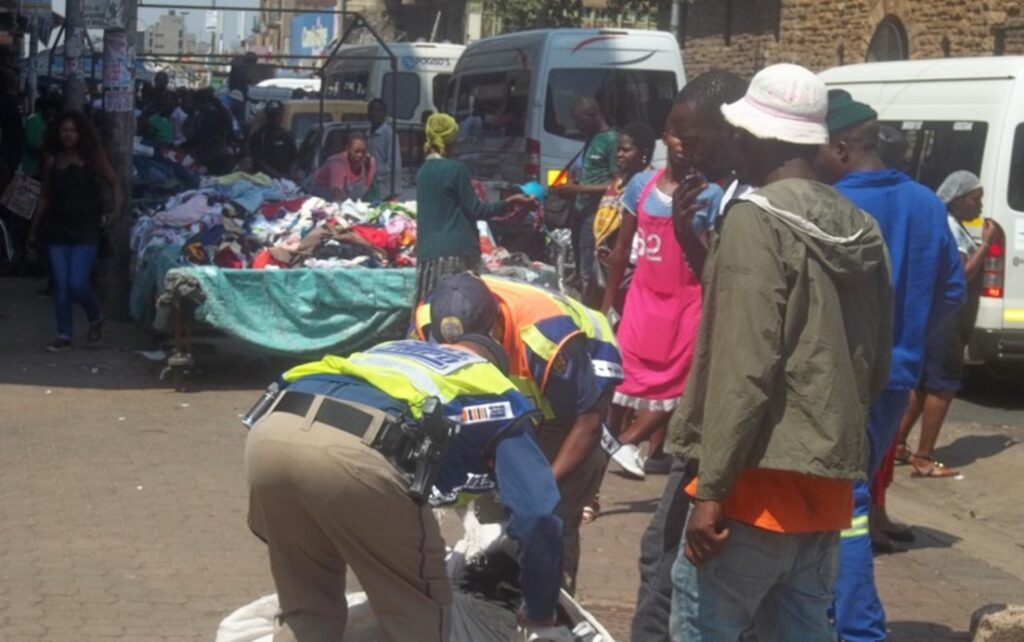
This repetition highlights how certain governance logics persist, even as administrations change. It raises critical questions about accountability and the uneven temporalities of urban policy: Why do the same practices reappear despite new mandates and frameworks? Why is a developmental policy overlooked in favour of outdated bylaws? And why does the muncipality continually underestimate the scale and importance of informal trading?
Part of the answer lies in the inherited institutional architecture that continues to guide everyday decision-making. Johannesburg’s informal trading by-laws date back to 2012, and despite the adoption of a more developmental 2022 policy, the older by-laws remain the primary legal instrument used by enforcement officials. This creates a disconnect between progressive policy intentions and on-the-ground implementation. The result is a governance environment in which historical regulatory tools still shape present outcomes, an example of how earlier spatial and administrative regimes remain embedded in contemporary regional life.
Another part of the story is political incentives. Administrations under pressure to signal control or decisiveness often target informal traders because they are visible, vulnerable, and easily framed as contributors to “disorder.” This reproduces a cyclical pattern where informal traders absorb the consequences of political transitions, even though they contribute to employment and poverty reduction.
Understanding Johannesburg as a historical region helps illuminate why these patterns persist. The city carries layered legacies of planning, displacement, modernist visions, and fragmented governance. These layers shape both the possibilities and constraints of current policy and its implementation. Even when a new framework like the 2022 Informal Trading Policy is introduced, older logics such as enforcement-heavy approaches, and resistence towards informality, continue to guide practice.
Yet understanding these dynamics presents an opportunity. If the city recognises its embedded dynamics, it can begin to confront the deeper structural issues that prevent meaningful change that integrates, rather than dismiss, informality. This requires viewing informal trading not as a temporary activity but as a permanent and essential part of Johannesburg’s urban landscape. The question is whether the City will finally break with the past and build a more inclusive future, or whether it will remain trapped in cycles of repetition, changing leaders and policies but clinging to the same old practices.
Footnotes:
[1] This is South Africa’s oldest and historically dominant political party, which led the struggle against apartheid and has been governing the country since its first democratic elections in 1994. It currently remains the ruling party, advocating for social and economic transformation, though it faces criticism over corruption, service delivery challenges, and internal factionalism.
[2] This is South Africa’s main opposition party, advocating for liberal democracy, market-oriented policies, and efficient governance.
Connect with the Author

Mamokete Modiba is a Senior Researcher at the Gauteng City-Region Observatory, where she leads the Inclusive Economies Research Programme. With a background in urban planning and urban studies, her work spans a range of interconnected fields, including informal economies, township economic development, small business development, urban governance and just urban transitions. Her research examines how structural inequalities shape livelihood opportunities in cities, with particular attention to marginalised groups and under-resourced areas. Committed to socio-economic justice, Dr Modiba produces policy-relevant scholarship that bridges research and practice, contributing to more inclusive, equitable, and context-responsive urban development in Gauteng and beyond
 :
:  :
:  :
: