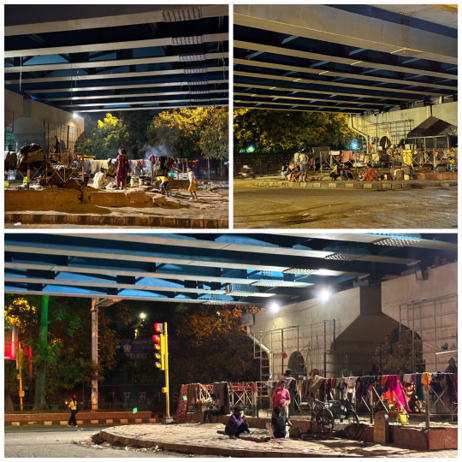
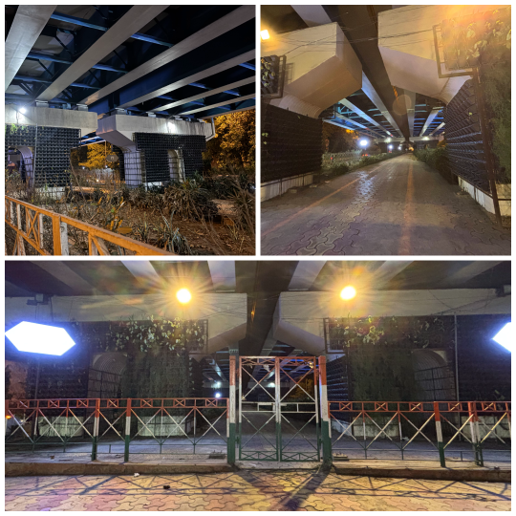
Stand under almost any flyover in Delhi long enough, and the underside tells two different stories at once. On one side, the columns are caged behind iron grilles, the ground planted with neat rows of vertical greenery in modular black containers, the walkway swept and empty. On the other hand, life is visibly happening: bedding rolled out against a barrier, a cooking fire, washing strung between pillars, and people sitting where the concrete meets the road. Same flyover, same structure overhead, two completely different uses of the same residual space, sometimes separated by no more than a hundred meters.
Delhi’s road surfaces are not background detail here; they are part of the argument. Infrared readings taken on ordinary days during the 2026 heat season, not even the worst ones, recorded road surface temperatures above 55°C across the city (Down To Earth, 2026). Children who work these intersections through the day, selling pens, balloons, or loose roses for a few rupees at a time, have nowhere shaded to recover between rounds. A planted, lit, and cooled stretch of pavement is exactly the kind of relief that heat-exposure research says they need. It is also the stretch they are not allowed to enter.
Engineered, not incidental
I started photographing the undersides of flyovers as a side note to doctoral fieldwork on urban green infrastructure in Delhi, expecting to document plant cover, not people. What stopped me was this split condition, repeated under flyover after flyover across the city. Urban greening research rarely asks what happens to the people already using a space once the planters arrive. A growing literature on green gentrification has shown that the benefits of urban greening are rarely distributed evenly, and that the people displaced by it are usually the ones least equipped to contest the loss (Anguelovski et al., 2019). Delhi’s flyovers look like an unstudied instance of the same pattern, just without the rent increases that usually mark green gentrification elsewhere.
The locked side did not become unusable by accident. The grilles, the barricades, the dense planting along every open edge are a built solution to a specific problem: occupation. Planters sit exactly where a person could otherwise lie down. Enclosures are locked, not just fenced. Lighting angles outward across a swept, empty walkway rather than toward any functional path. None of this reads as incidental. It reads as engineered.
At one access point, the design goes a step further than fencing: entry is through a single gate, with a watchman posted to decide, in real time, who comes in. That matters more than the grilles do, because it moves the mechanism from architecture to judgment. But it would be a mistake to read it as proof that someone decided to exclude homeless residents specifically. The watchman is almost certainly enforcing a generic brief: protect the plantings, keep the space tidy, and no loitering. Nobody named anyone in that instruction, which is exactly how dispersed accountability survives contact with an actual decision point. A vague mandate gets executed by someone with no authority to question it, and the population it excludes is never written down anywhere.
A governance pattern, not a single decision
What makes this worth a regional studies audience’s attention, rather than a local interest story, is the chain of actors above that watchman and the policy framework that assembles them. Delhi’s Public Works Department has formalised this multi-actor model through signed MoUs with private corporations under its ‘adopt a flyover’ policy, under which companies fund and execute beautification as a CSR activity while PWD retains structural oversight. The policy explicitly names the removal of homeless persons as a concurrent objective alongside beautification, yet no term in the MoU chain reports assigning responsibility for rehabilitation or alternative shelter (Indian Express, 2025). A municipal corporation commissions the landscaping. A public works department manages the flyover’s structural elements. A corporate sponsor funds it under a CSR mandate and collects a plaque and a press photo. A design contractor executes the plan. Each actor performs a narrow, defensible part of a larger outcome, none of which they individually authored, which is why the brief never had to mention rehabilitation for rehabilitation to be nobody’s problem.
This institutional pattern is not unique to Delhi, and that is the point. Cities across Europe run comparable nature-based solutions programmes under sustainability mandates, with the same combination of municipal authority, private capital, and design intermediaries operating without a shared accountability structure. The governance gap is the transferable finding, not the flyover. Wherever beautification runs through a coalition rather than a single accountable body, the people occupying the space being beautified are structurally the easiest party to leave out of the conversation, because no single office ever had to have that conversation with them.
What governance left unaddressed
The distributive cost is straightforward. A residual urban common becomes a managed aesthetic asset, with no alternative shelter offered in exchange. The recognition cost is quieter. Nobody had to argue that homeless residents’ claim to that space was illegitimate. The claim simply stopped being addressed, which aligns more with what Nancy Fraser (1995) called misrecognition than with an explicit denial: the harm was never put up for argument at all, but was instead reframed as an environmental improvement problem with an engineering solution. Erasure through good intentions is harder to challenge than erasure through an explicit decision, because there is no decision on record.
None of this is an argument against urban greening. It is an argument against governing it as though residual space is neutral ground rather than space someone already occupies. Three changes would close most of the gap. Greening proposals affecting occupied residual space should require documented consultation with current occupants before design begins, not after. Funding agreements should name which actor is accountable for displacement outcomes, not only for landscaping outcomes. And residual urban space generally, flyover underpasses, drainage margins, leftover road land, should be treated in planning frameworks as contested commons, not blank canvas awaiting improvement.
The next time a flyover underpass in your own city gets a green makeover, it is worth walking the full length of it. The contrast, if it is there, will not be subtle. It rarely is.
Connect with the Author

Ravindra Singh is a PhD candidate at the Center for the Study of Regional Development, Jawaharlal Nehru University, New Delhi, supported by a UGC Junior Research Fellowship. His doctoral research examines spatial justice and urban green infrastructure in Delhi across distributive, procedural, and recognition justice dimensions, combining GIS-based spatial modeling with governance analysis. He has contributed as a consultant to the Shahjahanpur City Heat Action Plan 2026 and has published peer-reviewed book chapters in TU Delft Open Publishing’s series on the just city. His work engages questions of urban inequality, climate adaptation, and green space governance in cities of the Global South.
 : Ravindra Singh
  :
: