Innovation is often seen as a universal force for good, a driver of economic growth and improvements in living conditions. However, innovation also has a “dark side” (Coad et al., 2022). Past industrial breakthroughs, from battery manufacturing to steel production, fueled massive economic growth but left a toxic legacy of heavy metals such as arsenic, lead, and mercury. These contaminants are persistent, carcinogenic, and pose severe risks to public health and ecosystems even decades after their industrial deployment.
The downside of innovation does not merely refer to historical damages, but includes the failure of the current technological landscape to weed out these burdens (Coad, Biggi & Giuliani, 2021). Due to the specificities of polluted areas and contaminant mixes, environmental threats should incentivize the development of local solutions. Consequently, we might expect regions suffering from high contamination to be the first to develop remediation technologies to clean up their polluted soils.
However, our recent research (Biggi & Iori, 2025) shows that this innovative response is far from automatic. So, why do some regions innovate in remediation technologies while others remain inert? To understand this, we must look at a region’s industrial trajectory.
Deindustrialization and the loss of “Industrial DNA”
As Dosi, Riccio & Virgillito (2021) argue, “microchips” are not “potato chips”. The specific type of manufacturing matters because technological learning, capability accumulation, and increasing returns vary significantly between high-tech science-based sectors and traditional industries. We observe a stark contrast when we compare industrial hubs with regions that have lost their industries entirely.
Technological capabilities are cumulative. When a region deindustrializes without transitioning to new knowledge-intensive sectors, it loses its industrial DNA, including engineers, specialized infrastructure, and institutional knowledge required to develop innovation and solve its pressing environmental problems. Our findings show that a proactive innovation response to soil contamination is only found in regions that are not deindustrialized and not economically lagging. These areas have retained the necessary capabilities to turn an environmental challenge into a technological opportunity, whereas fully deindustrialized regions are left with a capability vacuum and institutional weaknesses.
Mapping the innovative responses
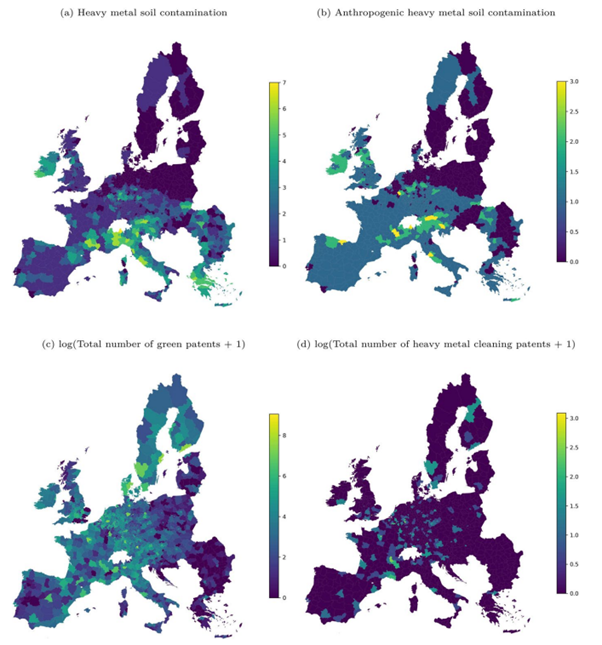
To uncover these patterns, we moved beyond traditional green patent classifications, which are often too broad to capture specific remediation technologies. Specifically, we employed an innovative detection methodology using the CAS SciFinder-n database to analyze patents filed between 2000 and 2020, which provides chemical information associated with worldwide patents. This approach allowed us to identify patents specifically designed for the removal or cleaning of heavy metals from the environment, distinguishing general green inventions from targeted remediation technologies.
We combined these patent data with high-resolution soil data from the JRC LUCAS Topsoil database, which maps heavy metal concentrations at over 23,000 points across the European Union (EU) and the UK. By overlaying these datasets, we detected where the innovative response was happening and where it was missing.
|
|
The ecological trap of “left-behind” places
The inability to respond to local environmental hazards deepens the regional divide. This resonates with Rodríguez-Pose’s (2018) work on the rise of discontent in “left-behind” places.
Regions that have experienced severe industrial decline are burdened twice:
- They suffer from the persistent environmental damage of past industries.
- They lack the current technological and economic capacity to innovate their way out of it.
In these left-behind areas, the relationship between contamination and innovation is negligible or entirely non-existent. In other words, they are ecologically trapped by their own economic stagnation.
Bridging the green divide
The policy implications are urgent. Initiatives like the European Green Deal often assume that green growth is a universal rising tide. Our evidence suggests otherwise. If we rely on market forces alone, the gap between wealthy technological hubs and post-industrial regions will only widen.
Policymakers must implement targeted, place-based interventions specifically for left-behind regions. Funding general green technologies is not enough. Indeed, green innovation policies must help these regions rebuild the specialized technological capabilities needed for an inclusive ecological transition.
Participation in the green economy is also about ensuring regions have the tools to clean up the ghosts of their industrial past. We cannot achieve a truly sustainable future if our most polluted regions are also our most inert. It’s time to bridge the green divide.
Offline References
Coad, A., Nightingale, P., Stilgoe, J., & Vezzani, A. (2022). The dark side of innovation. Industry and Innovation, 28(1), 102-112.
Connect with the Author

Gianluca Biggi is a Tenure-track Assistant Professor at the Institute of Economics of Scuola Superiore Sant’Anna. He got a PhD in Management from the University of Pisa in 2021. His research focuses on the economics and management of innovation and the strategic implications of emerging technologies. During his PhD, he developed a novel methodology that integrates chemical information extracted from patents with computational chemistry tools, enabling a deeper understanding of the nature and evolution of chemical inventions.
 : Gianluca Biggi
  : 0000-0001-6777-7111
  : gianlucabiggi.bsky.social

Martina Iori is a Tenure-Track Assistant Professor at the Department of Economic Policy, Università Cattolica del Sacro Cuore – Milano, and an affiliated researcher at the Institute of Economics, Scuola Superiore Sant’Anna. She earned her PhD in Economics from the University of Turin and Collegio Carlo Alberto. Her research combines econometric techniques, advanced computational tools, and a regional perspective to investigate the drivers of innovation and scientific discovery.
: Martina Iori : 0000-0001-6825-2165 : martinaiori.bsky.social  : martina_iori