The two cities of Macau and Zhuhai, located on the south-east coastline of China, have long been entangled. Both were administered by Xiangshan County for centuries before Macau came under Portuguese administration. Even under segregated jurisdictions, interactions between the two governments continued to produce entangled places.
The entanglements of places and territories between Macau and Zhuhai
During the mid-twentieth century, Macau and Zhuhai collaborated on land reclamation in the waters of the Canal de Taipa, also known in Chinese as Shizimen (十字门), effectively erasing the canal from the map. The name of the place, however, did not disappear; instead, it drifted onto Zhuhai’s territory and became associated with a peripheral area that remained relatively underdeveloped until the late 2000s. Its development was sparked by China’s national strategies that placed strong emphasis on Macau–Zhuhai integration and the development of urban peripheries to bridge the two cities, which was driven by the regionalization agenda of the Pearl River Delta, which encompasses nine cities, including Macau and Zhuhai (Tan et al., 2019; Li, 2023; Wang, 2010).
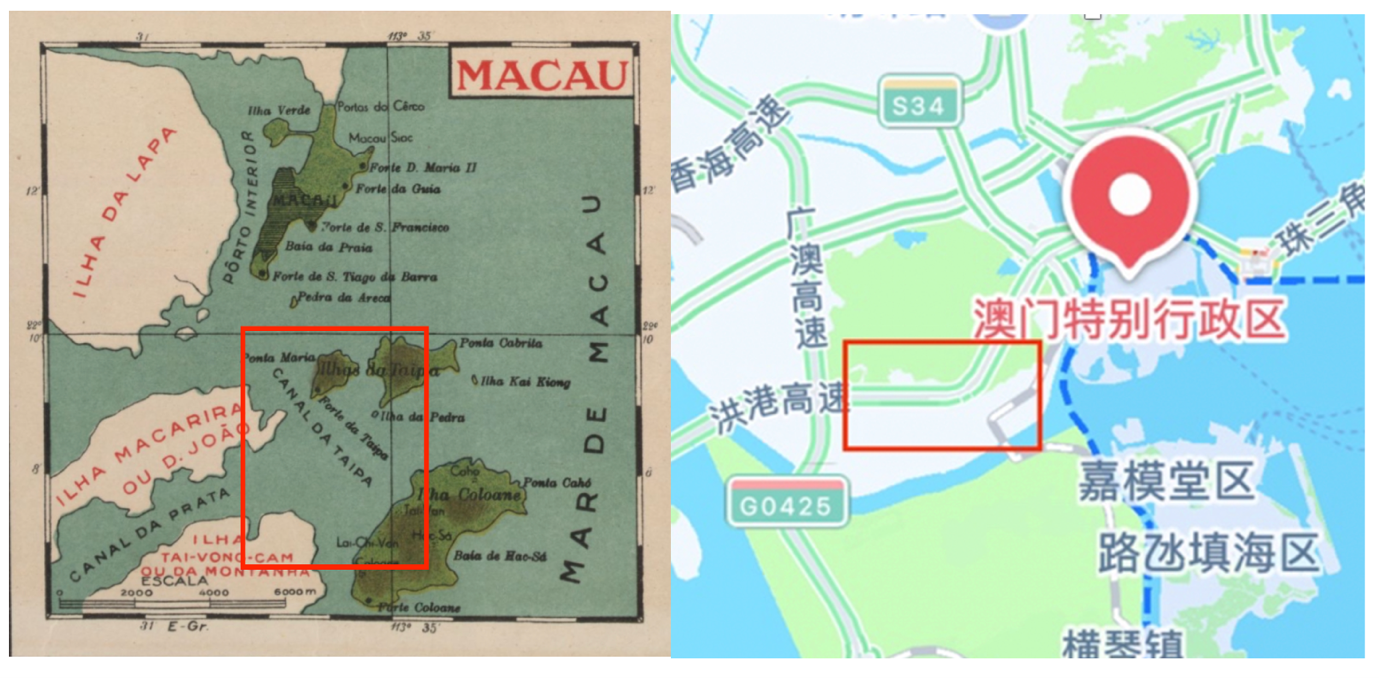

Within this context, in 2009, the administrative right to a plot of land in Zhuhai was granted to the Macau government through a lease for the construction and operation of the University of Macau (UM). This arrangement allows Macau laws and policies to operate fully within the UM campus, subject to monitoring, creating a Macau jurisdictional enclave within mainland Chinese territory. With strong attention from the central government, the establishment of this enclave was not merely a regional higher education policy, but a major geopolitical decision intended to demonstrate the institutional potential of China’s “one country, two systems” framework (Xia & Xiong, 2009; Chen, 2010; Liang & He, 2023).
Making sense of entangled places in a context of government-orchestrated regionalization
UM students experience the spatial entanglements between Macau and Zhuhai most directly. Encouraged by regionalization policies and peripheral development, the present-day Shizimen area has been rapidly developed. It offers students who do not have a home in Macau (mainly from mainland China) a cheaper rental option and lower living costs compared to renting and living elsewhere (Wang, 2010). These students commute daily between a place name originally associated with Macau but now referring to Zhuhai, and a location that is territorially in Zhuhai but administratively governed by Macau. This produces a distinctive place experience composed of two layers: a fuzzy intermediate place and a firm but passive border.
During my fieldwork, UM student interviewees who commute daily between Shizimen and UM were asked whether they felt where they were studying: in Macau or in Zhuhai? The most common response was: UM feels like neither. On the one hand, UM is clearly not Zhuhai. Students are aware that the campus is under Macau administration, requiring mainland students to obtain a Macau visa and to follow Macau governance in everyday practices, such as traffic rules that prohibit cycling for daily commuting, accessing the internet, and a style of education not available in Mainland China. On the other hand, UM is not Macau either. The campus’s spacious and polished built environment contrasts sharply with Macau’s narrow, jumbled, and organic streets. UM is associated primarily with education, while the “real” Macau is linked to other, more non-routine aspects of student life.
Frequent border crossings further shape students’ perceptions of the Macau–Zhuhai boundary. The border has become passive and mundane, crossed almost on autopilot with little alertness paid to customs checks. Yet its presence remains strongly felt, from the colder lighting and stronger air-conditioning on the Macau side of the checkpoint that notifies entrance to Macau territory, to the frustration of spending nearly an hour traveling only a few hundred meters in a straight line. The border itself and the differences between Macau and Zhuhai that it represents are repeatedly encountered, but are perceived with reduced weight and vigilance.
Conclusion
Top-down conceptions of places and borders clearly manifest in everyday life, yet the personal place experiences transform the interpretations made upon them. Students understand the geopolitical rationale for “one country, two systems” as an artificial third intermediate space that offers access to international information, westernized education, and lower living costs in mainland China. But despite its geopolitical intent, this space resembles neither side. Procedural changes intended to make border crossings more “swift and convenient” (State Council, 2021) have not removed the border, but have shifted perceptions of it towards a less demanding and more passive form.
Through living between Macau and Zhuhai, the shifting and drifting territories and borders of the two cities dissolve into the daily lives of the students, often unconsciously, but leaving visible trails of the entanglements between the two cities. This experience raises students’ awareness of the geopolitical intentions behind regionalization, yet these intentions are rendered less significant, as perceptions increasingly rely on personal and bodily experiences. The students’ participation in the regionalization process, alongside government orchestration, in shaping the region is undeniable; meanwhile, how such individual reinterpretations can ultimately reshape the region beyond state orchestration remains to be seen.
Connect with the Author

Siyi Huang, MPhil, is a PhD candidate at the Department of Land Economy, University of Cambridge, and a visiting student at Shenzhen University. Her research combines regional policy studies and human geography to explore China’s regionalization agendas, focusing on how they are received, experienced, and perceived, and how they are fed back into the shaping of the region.