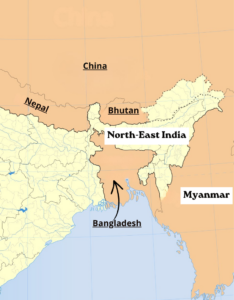
The civil war in Myanmar following the February 2021 military coup has generated one of South and Southeast Asia’s least acknowledged displacement crises. While international attention has focused on diplomatic stalemates and armed resistance inside Myanmar, the human consequences have unfolded quietly across India’s northeastern borderlands. In states such as Mizoram and Manipur, thousands of Chin and Kuki refugees have crossed into India, exposing the absence of a coherent refugee protection framework and revealing how borders function less as lines of control than as zones of legal ambiguity (Sanayaima, 2024; Sharma, 2023).
For India, this is a crisis of citizenship, federal governance, and democratic accountability. India’s approach to refugees remains ad hoc and discretionary. As a non-signatory to the 1951 Refugee Convention and its 1967 Protocol, India lacks a domestic asylum law and instead manages displaced populations through executive orders, police discretion, and informal tolerance (Patel, 2016; Chimni, 2011). Myanmar refugees are officially categorized as “illegal migrants,” a designation that strips them of legal protection and excludes them from public welfare, education, and lawful employment (Khan, 2024).
By avoiding formal recognition, the Indian state retains flexibility while transferring the costs of displacement to local governments, civil society, and border communities. Refugees survive through church networks, kinship ties, and informal labor markets, all while remaining vulnerable to detention, deportation, and exploitation (Khan, 2024; Dimitriadis, 2023; Betts, 2013).
Borderlands and Belonging: Ethnicity Beyond the Nation-State
Displacement from Myanmar unsettles the territorial logic of Indian citizenship. Chin refugees share deep ethnic, linguistic, and familial ties with the Kuki-Zo population across Mizoram, Manipur, and parts of Nagaland. These cross-border continuities predate the modern nation-state and challenge the assumption that borders neatly divide political communities (Shimray, 2004; Karlsson, 2011).
In Mizoram, ethnic solidarity has translated into relatively humane responses, with local authorities openly defying central directives to deport refugees. In Manipur, however, refugee arrivals have intersected with long-standing ethnic and political tensions, intensifying anxieties around land, representation, and demographic change (CA, 2025). Refugees are increasingly framed not as victims of violence but as agents of instability, a narrative that legitimizes exclusion and surveillance.
Securitization and the Criminalization of Survival
India’s recent decision to suspend the Free Movement Regime along the Myanmar border marks a decisive shift toward securitization. While justified as a counterinsurgency measure, tighter border controls disproportionately affect displaced civilians rather than armed groups, who continue to exploit informal routes (Behera, 2016; Baruah, 2020). For refugees, insecurity is no longer episodic but permanent. Restricted mobility, fear of arrest, lack of documentation, and exclusion from formal livelihoods produce a condition of everyday precarity. This form of governance, neither inclusion nor expulsion, effectively criminalizes survival while absolving the state of long-term responsibility.
The Myanmar refugee crisis has also exposed tensions within India’s federal structure. Northeastern states bear the social, economic, and political costs of displacement but lack the authority or resources to formulate durable responses. Central insistence on securitization clashes with state-level humanitarian impulses, creating policy incoherence and legal uncertainty.
Conclusion: A Citizenship Crisis in Disguise
Myanmar’s war has transformed India’s Northeast into a testing ground for how the Indian state understands citizenship, sovereignty, and obligation. Treating displacement as a temporary security problem obscures its deeper implications. Refugees are not merely crossing borders; they are exposing the limits of India’s legal imagination. Without a rights-based refugee framework and a serious engagement with borderland realities, India risks normalizing precarity at its margins. In doing so, it undermines not only human security but the democratic promise of equal citizenship itself.
Connect with the Author

Bushra Ali Khan is an anthropologist, journalist, and research-driven communications professional working on border governance, geopolitics, and international human rights. Her work examines displacement, climate change, and security through postcolonial and feminist lenses across academic, policy, and media spaces. She is the author of multiple publications and divides her time between London and New Delhi.
 : kbushra