Policymakers often rely on familiar indicators such as GDP, employment rates, and education levels to assess regional well-being. Yet these metrics tell only part of the story. Human flourishing, encompassing happiness, health, purpose, virtue, relationships, and financial stability, is increasingly recognized as a vital complement to traditional economic indicators (VanderWeele et. al, 2020). However, existing measures fail to offer the fine spatial and temporal granularity needed to study how flourishing evolves across regions and time.
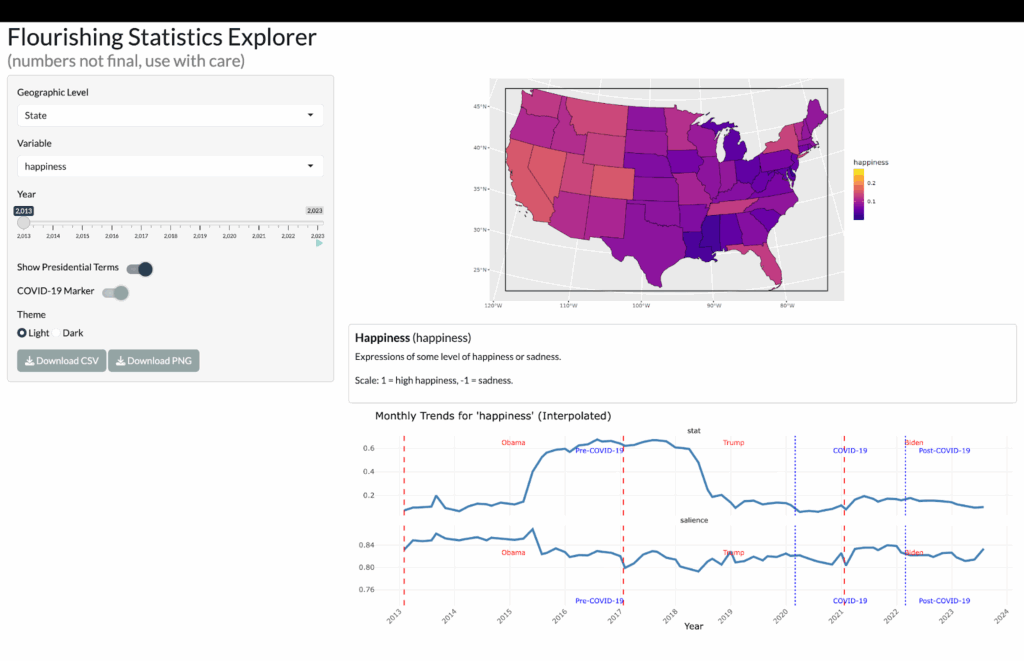
Human Flourishing Geographic Index (HFGI), introduces a novel way to understand regional well-being at fine-grained census-level detail across the United States. Using 2.6 billion geolocated tweets from 2013 to 2023 and a fine-tuned large language model, we generate monthly and yearly state and county-level indicators across 48 dimensions of flourishing ranging from happiness and depression to belonging, purpose and more. This dataset enables us to analyse the emotional and social well-being of regions across space and time. In addition, our Human Flourishing Explorer provides a high-resolution, interactive way to analyse and visualize HFGI.
Filling the Gap in Regional Studies on Flourishing
Regional studies scholars have long argued that space matters not only for economic outcomes but for identity, cohesion, well-being, and life chances (Storper, M. 1997). Yet the field has lacked large-scale, dynamic indicators that capture lived social and emotional experience across space and time. Existing well-being measures, while valuable, rarely provide the spatial and temporal granularity required to understand how flourishing evolves within and across regions (Okulicz-Kozaryn, A., 2011).
National level reports can obscure what is unfolding on a regional level. Flourishing is unevenly distributed across space (Morrison & Weckroth, 2018). It varies with local economies, social ties, demographic composition, migration patterns, environmental pressures, and historical legacies. Therefore, a fine-grained regional dataset is critical for measuring regional flourishing. HFGI fills this gap by providing county and state level data for 48 measures spanning emotional, moral, social, economic, civic, and spiritual domains for a decade. This dataset opens new directions for regional analysis of well-being. It provides granular insight to policymakers, international organizations such as the UN and World Bank, and the general public, enabling data-driven interventions and community empowerment to address regional disparities and improve quality of life. It supports high resolution monitoring of well-being, identification of geographic inequalities, evaluation of policy impacts in near real time, and the integration of social cohesion, trust, and emotional well-being into equitable policy design.
How can HFGI transform regional flourishing studies?
Regional studies have always focused on place-based inequality, spatial identity, and regional cohesion. Yet empirical tools have largely captured only structural factors such as employment, migration, education, and health outcomes. HFGI introduces emotional and social dimensions into regional flourishing analysis by:
- Revealing hidden forms of regional disadvantage
Traditional datasets capture income, education, housing, and other structural metrics. But flourishing gaps often emerge earlier and more subtly. HFGI helps identify regions where financial worry remains persistently high, depression spikes after shocks, belonging erodes even when unemployment is low, or civic engagement stagnates. These softer indicators can serve as early warnings of regional decline.
- Understanding regional resilience
Some regions recover rapidly from disasters, job losses, or political upheaval, while others struggle. HFGI captures shifts in sentiment, optimism, and cohesion, which together shape a region’s resilience. Temporal data allows researchers to trace emotional recovery, identify communities experiencing emotional precarity, and evaluate whether investments in local institutions strengthen belonging and purpose.
- Enriching analysis of spatial inequality
The geography of flourishing does not necessarily mirror the geography of development. HFGI supports exploration of questions such as whether left-behind places are emotionally left behind as well, whether high-growth regions experience deficits in belonging or meaning, and how migration flows reflect emotional rather than purely economic geographies.
- Supporting regional policy design
Regional development strategies often emphasize infrastructure, jobs, and investment. Yet people’s willingness to stay, participate, and collaborate is deeply shaped by emotional and social well-being. HFGI can guide interventions that strengthen community cohesion, mental health infrastructure, civic engagement, and local narratives of hope and purpose. It encourages regions to set flourishing targets alongside economic ones.
- Enabling cross-scale comparisons
With monthly data for every U.S. county, researchers can compare trends across regions, examine rural and urban trajectories, assess the impact of state level policies on local flourishing, and study how local shocks ripple across broader areas. Flourishing becomes visible as a regional phenomenon rather than merely an individual one.
Preliminary regional analysis results from the HFGI
Our preliminary analyses of the HFGI is already revealing several interesting regional patterns including but not limited to:
- Strong regional clustering
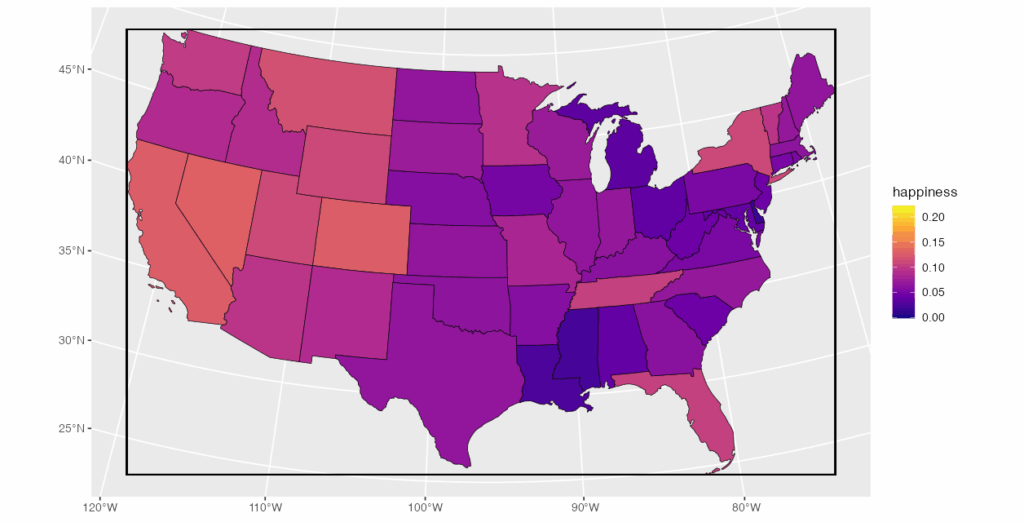
Expressions of happiness, belonging, financial worry, and civic frustration form coherent spatial patterns. Indicating a possible east-west trend. Purpose and faith are more visible in many rural regions. Civic engagement seems to be expressed more in coastal areas. Financial sentiments appears more frequently in rural belts.
- Rural and urban contrasts
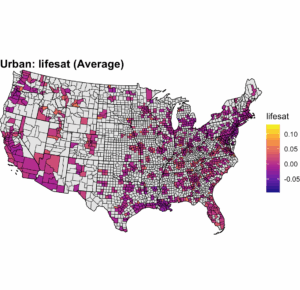
Rural counties consistently express strong sentiments related to life satisfaction, meaning, purpose, virtue, and religious commitment. Metropolitan counties more often express civic attitudes such as volunteering, charity, and institutional critique. These findings reflect long-observed socio-spatial differences, but the HFGI allows us to observe their evolution in real time.
 |
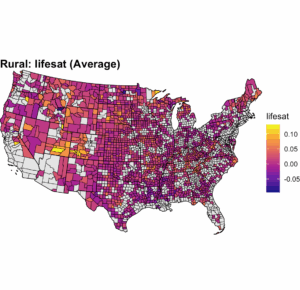 |
Figure 3: Expression of life satisfaction showing a possible rural-urban trend
- Distinctive local anomalies
Some counties diverge sharply from their regional contexts, showing that flourishing is shaped by regional cultures, shocks, leadership, and community fabric. These anomalies, previously difficult to study systematically, have now become more visible and analyzable through HFGI.
Toward a Regional Policy of Flourishing
HFGI marks a shift in how we think about regional development. For regions grappling with demographic change, economic restructuring, or social fragmentation, understanding emotional and social dynamics may be as essential as investing in infrastructure. As flourishing is unevenly distributed across space, measuring it at a regional scale allows development strategies to aim not only for economically successful regions, but for truly flourishing ones.
Read More about this research: Iacus, S. M., Jain, D., Nasuto, A., Porro, G., Carammia, M., & Vezzulli, A. (2025). The Human Flourishing Geographic Index: A county-level dataset for the United States, 2013–2023. (Currently under revision in Nature)
Additional References:
- Iacus, S. M., & Porro, G. (2025). Job satisfaction through the lens of social media: Rural–urban patterns in the U.S.
- Iacus, S. M., & Porro, G. (2025). Two Americas of Well-Being: Divergent rural–urban patterns of life satisfaction and happiness from 2.6 billion social media posts.
Offline References:
- Storper, M. (1997). The regional world: Territorial development in a global economy. Guilford Press.
Connect with the Authors

Stefano Iacus is Scientific Officer at the European Centre for Algorithmic Transparency, Joint Research Centre of the European Commission, and an affiliate at the Institute for Quantitative Social Science (IQSS), Harvard University.
 : stefano.iacus@ec.europa.eu
  : Stefano Iacus

Devika Jain is Data Science Manager at Center for Geographic Analysis, Harvard University where she leads the area of GeoAI and Spatial Data Science.