A Cultural Tourism–Oriented Perspective
Crete is the largest island in Greece, positioned at the intersection of Europe, Asia, and Africa, and has historically served as a strategic point along major maritime routes. It relies heavily on its archaeological heritage tourism, particularly the legacy of the Minoan Civilization. In the past, the accounts from Herodotus and Thucydides provided some of the earliest literary references to King Minos, portraying him as a ruler who transformed Crete into a dominant maritime power in the Aegean. And in the present, the Palace of Knossos, the largest Minoan palace complex, draws approximately one million visitors each year. In total, 6 to 7 million people visit Crete annually, driven by ongoing international interest in Minoan archaeology, mythology, and Greek antiquity (Hellenic Statistical Authority, 2024; Bank of Greece, 2024). What people come to see is evidence of Crete’s cultural past in the Myths and Frescoes.
In Memory and The Myth: Daedalus and Minoan Frescoes
In Greek mythology, Daedalus represents an archetype of engineering innovation, craftsmanship, and creativity, and is prominently depicted in art and architecture, particularly in Minoan visual culture, particularly at Knossos. Moreover, in Myths such as the Pasiphae and Minotaur myth, he is credited with inventing devices such as the wooden cow. Or in the narrative of his escape with Icarus, he is said to have flown on wings made of feathers and wax. In both examples, he remains a powerful symbol of invention, ambition, and the ethical limits of technological advancement. The expression “flying too close to the sun” continues to signify excessive ambition or disregard for boundaries, underscoring the myth’s enduring relevance.
The Archaeological Discovery of Knossos
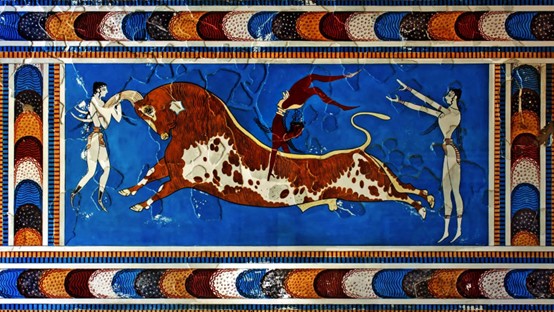
In the present context, this influence is evident in the elaborate frescoes decorating the interiors of Palaces, depicting daily life, rituals, processions, and the natural world (Evans, 1935; Cameron, Jones, Philippakis, 1977). Maritime themes (Figure 1) and ‘Sea Life’ artworks highlight the island’s maritime focus and artistic achievements, and some scholars such as Brake (2018) and Danylova (2018) have suggested the sea’s central role in Minoan cosmology, rituals, and daily life which still continue to shape interpretations of art history, cultural heritage, and the human connection to the sea (Shaw, 2012).
However, the archaeological sites at Knossos were extensively excavated by Arthur Evans in 1990, and since then, the findings have revealed a previously undocumented writing system and led to systematic, rigorous research (Evans, 1909; Fitton, 2002).
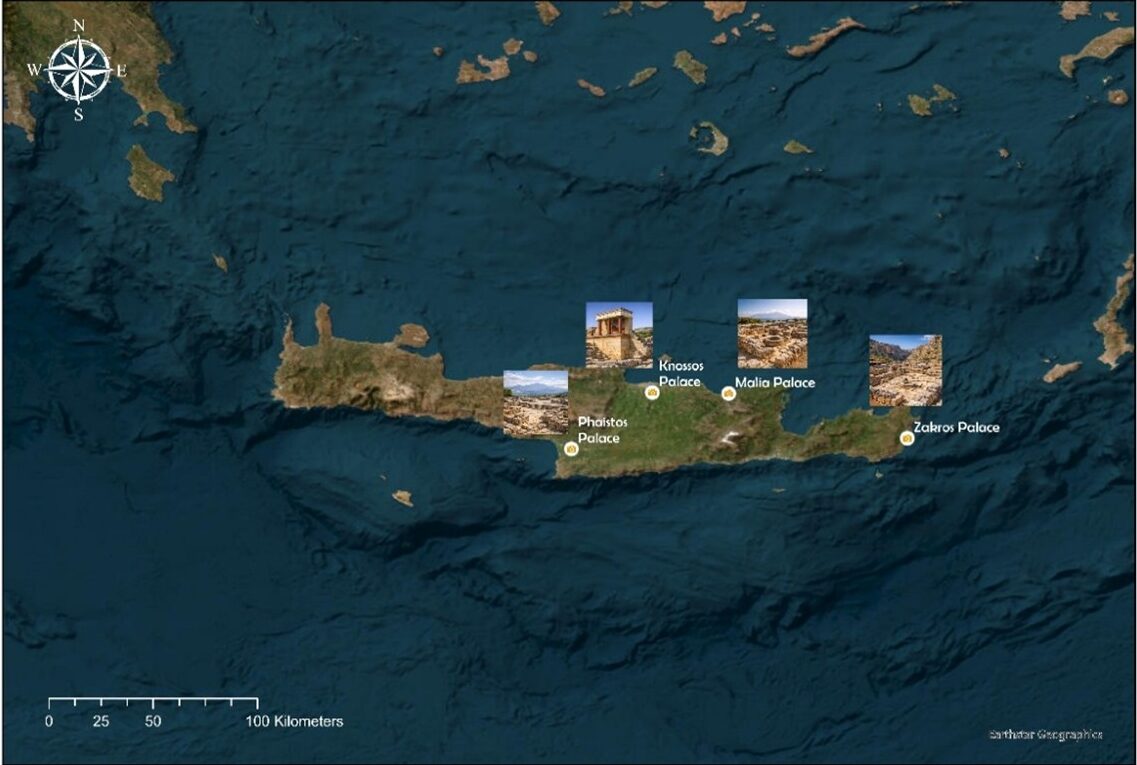
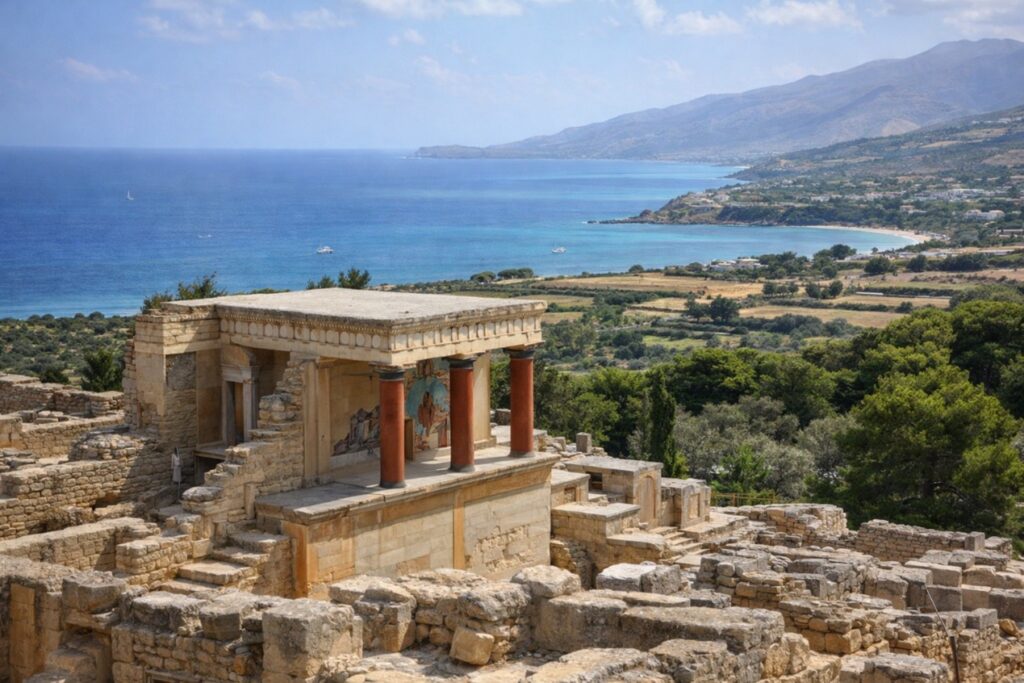
Knossos, Phaistos, Malia, and Zakros (Figure 2) each played key roles in administration, the economy, and religion. Knossos served as the main seat of power, Phaistos managed agriculture, Malia functioned as a trade center, and Zakros linked eastern commerce and ritual. Collectively, these sites formed the core of Minoan society and demonstrate the achievements and organization of one of Europe’s earliest civilizations (Evans, 1935).
The Museums: Interpreting Minoan Artifacts
Leading European institutions, including the Louvre, the Vatican Museums, and the Capitoline Museums, Museo Arqueológico Nacional, showcase (Figure 4) Greek, Roman, and Mediterranean antiquities acquired through excavations, historical collections, art purchases, and archaeological expeditions.
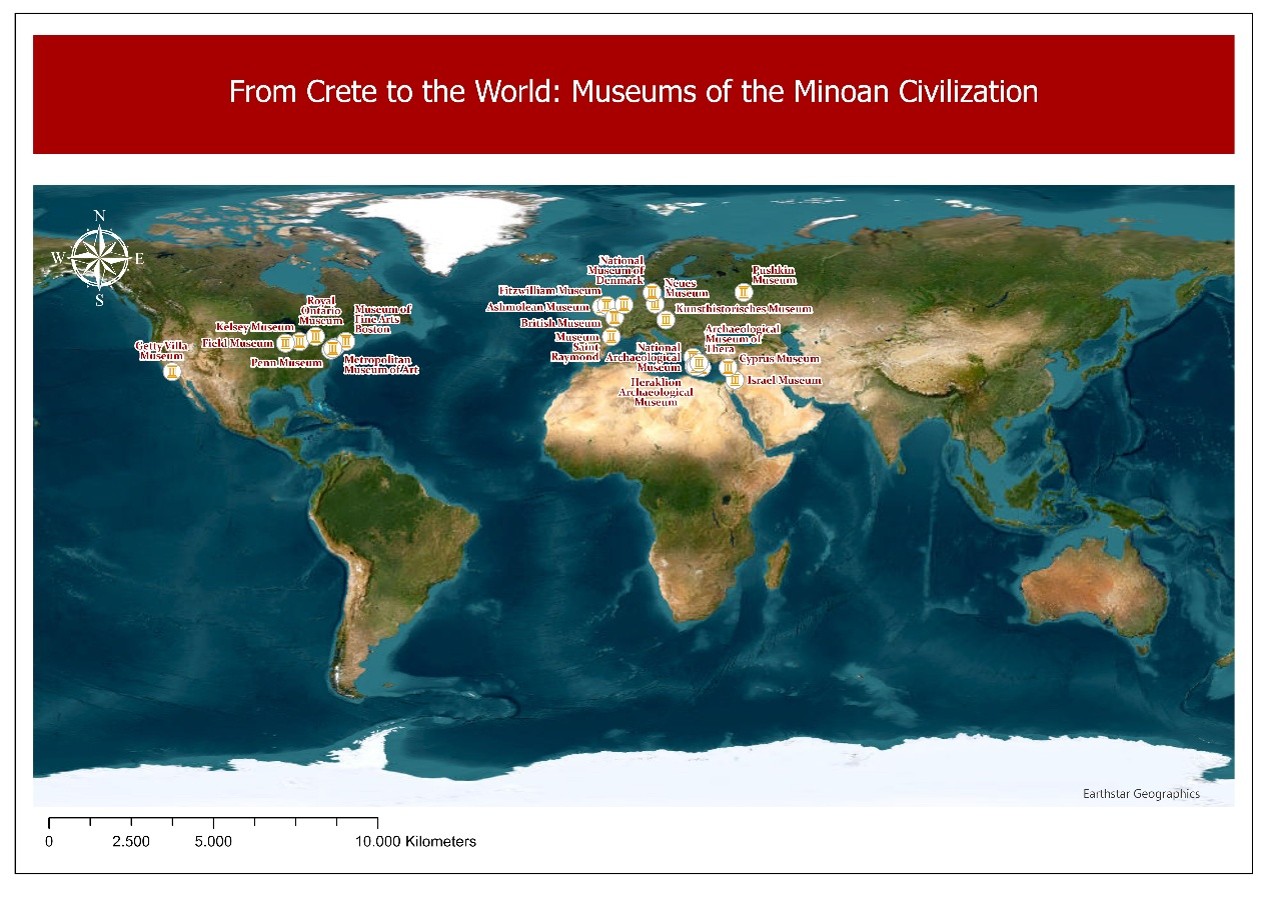
The British Museum in London also plays a significant role in presenting Minoan Civilization and displays a collection of Kamares Ware Cup, Minoan Seal Stones, Double Axe (Labrys), Gold Signet Ring, and Linear A Clay Tablets, offering insight into the daily life, artistic sophistication, and technological achievements of ancient Crete.
These legacies of Minoan civilization influences global art, and these artifacts showcase the enduring cultural impact, keeping alive ancient narratives that also shape modern identity, as well as myths that unify the historical pride of Greece with that of Crete. But the fascination with these heritage sites is not limited to national pride; it is also evident in global popular culture. For example, the 1957 Hollywood production of “The Child and the Dolphin” showcases the enduring appeal of archaeological themes in film. Therefore, apart from cultural capital creating national identity, Minoan monuments sustain local economies; thus, they are critical to advancing sustainable tourism and supporting Crete’s regional economy (Marinatos, 2010; Fitton, 2002), and must therefore be preserved and promoted as we move forward.
Offline References:
- Evans, A. (1935). The Palace of Minos at Knossos (Vols. 1–4). Macmillan.
- Hellenic Statistical Authority. (2024). Tourism statistics and visitor arrivals in Greek regions. Hellenic Statistical Authority. https://www.statistics.gr/en/statistics/-/publication/STO12/2024-M01
Connect with the Author

Efthymios Georgiou is a professional whose multifaceted career encompasses urban planning, cartography, photography, and adult education. Based in Athens, Greece, he has made significant contributions to spatial planning, cultural heritage preservation, and geoinformatics.
 : Efthimios Georgiou
 : 0000-0003-3908-2325