In west Belfast, a community group is campaigning for the council to formally adopt an alleyway they describe as dangerous (Lynch 2025). It is a small, almost bureaucratic request: recognise this lane as part of the public road network, so someone is responsible for maintaining it. Yet it captures something larger about how Belfast’s back alleys are changing, and about the gap between what residents are already doing and what planning systems are built to support.
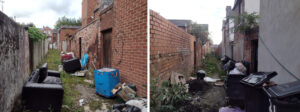
Belfast’s residential fabric is stitched through with alleyways, narrow passages running behind terraced housing, originally built for waste collection and rear access. The architecture and design collective 9ft in Common estimates the network at around 202 kilometers, threaded invisibly through the city, and their fieldwork found that only 7% currently show signs of growing projects or social use. My own research across five resident-led alleyway projects in Belfast confirms this pattern of quiet, uneven transformation (Silva 2026). Most of the network remains exactly what it was designed to be: backspace, not place (figure 1).
A network hiding in plain sight
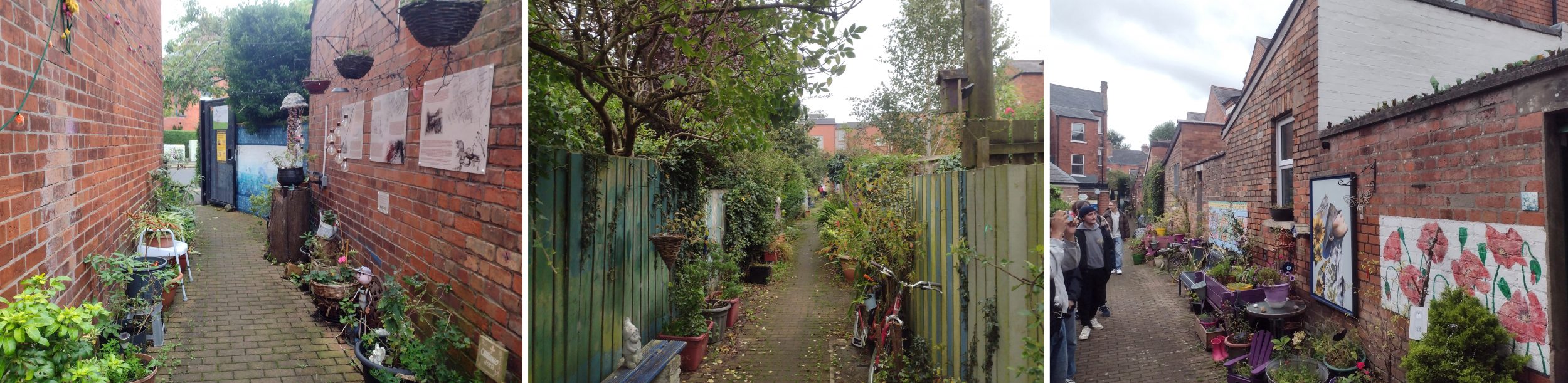
Across Belfast, resident groups have cleared, planted, gated, and repainted individual alleys, turning them into gardens, safer shortcuts, and informal gathering spaces (figure 2). In 2026, Belfast City Council secured $1 million from the Bloomberg Philanthropies Mayors Challenge, one of only 24 cities selected worldwide, specifically to scale up this kind of resident-led alley regeneration. What is less visible is the administrative status that determines whether any of this can be sustained. Belfast’s alleys are classified as either ‘adopted’ or ‘unadopted’ (Belfast City Council, 2020), in which ‘adopted’ alleys fall under the Department for Infrastructure (DfI) that oversees basic clearance and maintenance. ‘Unadopted’ alleys (the majority) have no designated public authority, and upkeep depends on residents or informal community planning and design initiatives. This distinction determines funding eligibility and the capacity to implement almost any improvement, from greening and alley-gating to waste management and schemes tackling anti-social behaviour (Lynch 2025). A resident-led project can transform an unadopted alley through sheer persistence, but it cannot access the support available to adopted ones.
Security, stewardship, and who decides
Where the council does intervene directly, it is largely through the Alleygates Programme, which has installed over 1,080 gates since 2005 (BBC Two 2025). Gating reduces crime and gives residents a stronger sense of safety, converting an open, ambiguous passage into a controlled, semi-private one. But it also redefines who has the right to pass through: residents describe gates as something that transforms communities, but that can also cut people off. My research across five community-led projects suggests that security and stewardship are where this governance tension shows its sharpest edge. In Miracle Way (southwest Belfast), an alley once marked by Troubles-era insecurity is now council-gated and resident-cleaned, repainted with murals and used for shared meals. In Rossmore-Ardmore, an enclosed layout gives residents informal oversight of who passes through. Eden Alley, by contrast, was cleared and planted by residents without any gating and relies instead on visibility and mutual watch to manage safety informally. None of these approaches is straightforwardly better than another, but what distinguishes them is who is responsible for making them work, i.e., gated alleys sit within a council programme with a funding line, while ungated ones depend entirely on sustained resident effort with no equivalent institutional backing.
This asymmetry sharpens whenever formal support stalls. In 2021, the then infrastructure minister announced a fund to green Belfast’s alleyways, promising more attractive, walkable, and cycle-friendly spaces (DfI 2021). That fund has since stalled – despite continued resident commitment – leaving communities in a state of governed improvisation. Across the five projects I studied, stewardship, meaning the ongoing cleaning, planting, and informal monitoring that keeps a transformed alley from reverting, consistently falls to residents, community groups, or design collectives (such as 9ft in Common), rarely matched by an equivalent institutional commitment to sustain it.
What could planning do differently?
None of this calls for a grand new alleyway strategy, but for planning systems to catch up with what residents have already proven works, and in that sense, maybe three shifts would help. First, clarify and speed up the adoption process, so that the willingness to maintain a space is not blocked by unclear responsibility. Second, fund ongoing stewardship (i.e., not only one-off capital improvements); so, cleared and planted alleys need continued care, and that care is currently unpaid and precarious. Finally, treat alleyways as neighbourhood infrastructure in their own right, integrated into mobility, greening, and community safety planning, rather than as leftover space that becomes visible only when a resident group forces the issue. The Bloomberg award is a chance to embed this shift, but only if it changes how alleys are governed, not just how many are funded.
But Belfast is not unique. Most UK cities with dense terraced housing have comparable alley networks, and comparable gaps between informal community action and the governance structures meant to support it. The lesson from Belfast’s alleys, however, is not that every city needs an alleyway strategy specifically, but that the systems built to manage ‘leftover’ space rarely keep pace with the people already living, working, and caring for it.
Connect with the Author

Cristian Silva is a Lecturer in Spatial Planning at Queen’s University Belfast and Programmme Director of the BSc in Planning, Environment and Development. Trained in architectural and urban design theory, his research examines interstitial and in-between urban spaces, with Belfast’s alleyways and interfaces as recurring case studies. This piece draws on his article ‘Interstitial placemaking: unpacking the domains of relational urbanism of Belfast’s alleyways’ (2026), published open access in the Journal of Urban Design.