Around one-quarter of the world’s labour force works in agriculture. In many low- to middle-income countries, labour in agriculture is one of the highest contributors. As WOTR notes in its article, women are often engaged in agricultural activities, but their work remains invisible. Stokes and Ghosh argue that this invisibility is best understood through the lived experiences of women, which reveal a deep schism between official political designations and their lived realities. This article presents the voices of women and their experiences in Sangamner, a semi-arid region of Maharashtra, India, as captured during rural fieldwork that included informal interviews and structured surveys conducted across 119 households and over 500 women to understand their agricultural livelihoods. Through their stories, I try to enhance the visibility of women engaged in agricultural activities, recognise their contributions, and highlight the contrast between official political designations and their lived realities.
The case: Life of a woman farmer at Sangamner
The regular day of a woman farmer in Sangamner starts with cooking breakfast for the family, followed by routine household chores. Her husband, an independent/hired farmer, receives his packed meal. She then heads to the fields as a labourer, undertaking physically intensive work like sowing, weeding, and harvesting. Despite working equally hard, if not harder, she earns 1.5 times less than her male counterparts, which amounts to a mere Rs. 250 daily, as stated in the interview, reflecting significant gender-based wage disparities. After 6-8 hours of relentless, exhausting labour, she returns home, cooks dinner, and completes her family care duties. While men dominate agricultural decision-making, women perform ground-level tasks with minimal recognition. However, this lived reality contrasts sharply with the official picture. At the Panchayat office, statistics show a seemingly balanced scenario: 966 females per 1000 males and 87.23% female literacy. Yet deeper inequalities persist—women’s voices remain unheard and their knowledge undervalued—an issue also highlighted in Anuradha’s study. Women-centric policies such as the Mazi Ladki Bahin Yojana (providing financial support to girls at various life stages) and Beti Bachao Beti Padhao (preventing female feticide and promoting education) are officially operational. Article 243D mandates at least 33% female Panchayat reservation, but impressively, Sangamner exceeds 50%. These policies shape Sangamner as a region that provides a strong framework for women’s empowerment and safety.
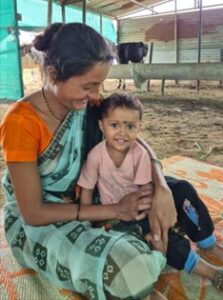
Contrasting? I felt the same way while compiling this information on my return from Sangamner. Despite a formal 50% representation, informal power remains male-dominated, as a female panchayat member shared:
“Decision toh sab 1-2 marad log lete hai. Hamari koi nahi sunta”
English Translation: Decisions are made by only one or two men. No one listens to us.
A few women had landholdings but knew little about their own land and crops.One farmer said,
“Humne shade-nets lagae lekin jaankari ki kami ke karan saari fasal jal gayi”
English Translation: We used shade-nets but our crops burnt due to lack of knowledge.
Showing resources are provided without enough guidance.
Women play a crucial role in agriculture by taking small yet essential steps, but their work is treated as insignificant and remains unacknowledged. These lived experiences from Sangamner powerfully voice their identity.
Sangamner’s story reflects how everyday community experiences contrast with official policy designations. On documents, women are empowered, involved in decision-making, and working freely. But in reality, they are either puppets of patriarchal mindsets or landless labourers working for the bare minimum wage Jain & Chacko (2011).
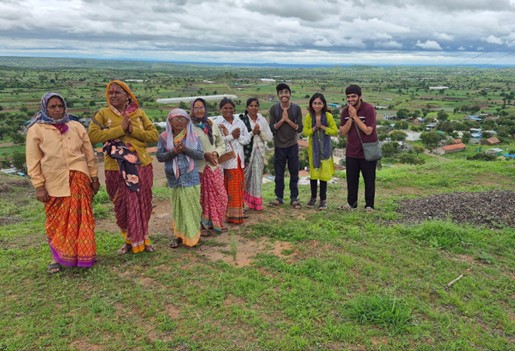
This contrast between policies and outcomes reflects a clash between a male-dominated mindset and the professional insistence on women’s empowerment in official documents. The result is a tyranny between success on paper and failure in reality. Policies might boost the system, but they cannot make empowerment sustainable.
Conclusion
This dichotomy between women’s lived experiences and official policy designations should not be seen as a flaw but as an opportunity to design more effective policies. Schemes like the Mazi Ladki Bahin Yojana and Beti Bachao Beti Padhao remain largely symbolic in Sangamner, as they fail to transform daily realities due to flawed delivery mechanisms, governance gaps, and the assumption that incentives alone can shift entrenched gender hierarchies. The clash between a male-dominated mindset in practice and professional insistence on women’s empowerment in documents creates a tyranny of success on paper but failure in reality. Bridging this divide requires policies that unmute women’s voices across fields, households, and governance. True change must be for the people, by the people, and to the people, moving beyond symbolic visibility to lasting impact.
Connect with the Author

Pranav Sharma is pursuing a BS in Analytics and Sustainability Studies. He is a second-year student at the Tata Institute of Social Sciences, Mumbai and could be described as a keen writer and a knowledge-seeking nerd who frequently observes society through an analytical lens and strongly believes in exploring sustainability within present-day solutions.
 : Pranav Sharma