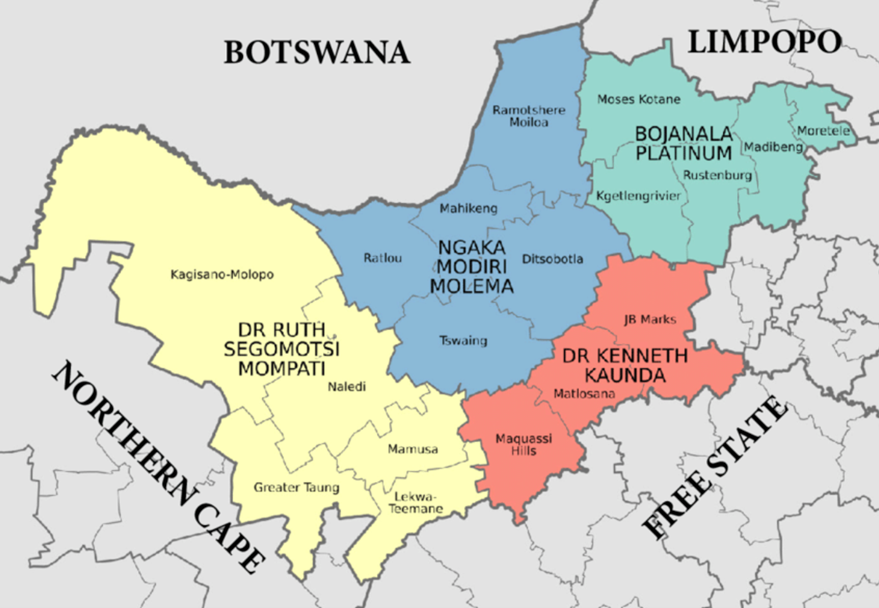
Economic diversification involves shifting away from a dominant sector to cultivate multiple industries that generate diverse income streams. Relying heavily on a single resource sector increases an economy’s vulnerability to the global commodity market and amplifies the risk of unemployment. South Africa’s North West Province is bordered by Botswana, Limpopo, the Free State, and the Northern Cape and consists of four district municipalities: Bojanala, Ngaka Modiri Molema, Dr. Ruth Segomotsi Mompati, and Dr. Kenneth Kaunda. These areas have experienced a significant out-migration to Gauteng since 1996, due to limited economic opportunities beyond the mineral sector. The North West Province initially developed as an agro-pastoral economy in the 1840s, with a focus on crop cultivation and livestock farming. However, the discovery of mineral deposits during the mid-1880s altered the economic base and heightened British interests. Since then, mining and agriculture have become the province’s economic foundations, with agricultural activities including maize, sunflower, and cattle farming, as well as the mining of platinum, gold, diamonds, granite, marble, and fluorite (DBSA, 2000).
Platinum was discovered near the town of Rustenburg by geologist Hans Merensky in 1921. Later, it got its name as the ‘Merensky Reef’ due to the increase in platinum mining activity, triggering a ‘platinum boom’ that attracted migrant workers to Rustenburg from other areas of South Africa (Mnwana, 2015). Platinum deposits attracted investment from several mining companies, including Impala Platinum Holdings and Anglo American Platinum. Global platinum demand and technological progress enhanced mineral extraction from the early 1980s; consequently, the town transitioned from an agricultural to a mining and quarrying-based economy.
Figure 1: Geographical location of South Africa’s North West Province
Structural Change (or lack thereof) in GDP Composition
Since then, the GDP share from agriculture has decreased, especially during the period from 1996 to 2004 (from 6.7% to 2.6%), making the economy extractive-intensive. At the same time, there was also minimal output from secondary industries, such as electricity, gas, water, construction, and manufacturing. However, mining and quarrying remained the province’s mainstay economy (Statistics South Africa, 2005).
Mining contributed to 20.1% of the province’s GDP in 1996, followed by general government services (13.9%) and wholesale, retail trade, hotels, and accommodation (12.3%). By 2004, mining had become the dominant sector, accounting for 24.9%, followed by finance, real estate, and business services (13.6%), and general government services (12.1%) (Quantec EasyData, 2025a). This dominance of mining in the share of provinces’ GDP continues to be the largest, with 25.1% in 2014 and 27.0% in 2023. Other sectors, such as community, social, and personal services (17.5 %), as well as finance, real estate, and business services (16.9%), formed the largest sectors in 2014. In contrast, in the same year, agriculture, construction, electricity, gas, and water each contributed below 3%, and manufacturing accounted for only 5.6%. By 2023, this pattern remained largely unchanged, with secondary sectors continuing to play only a marginal role.
This suggests that there has been no significant structural change over time in the economic sector, resulting in challenges in developing transportation and infrastructure, which in turn hinder the province’s economic growth and development. Additionally, it has struggled to attract significant manufacturing investments (Quantec EasyData, 2025a).
Despite this, Bojanala accounted for approximately 59.6% of the province’s GDP in 2024 (see Table 1). Therefore, it can be considered the core of the province, with a focus on platinum mining. Following this municipality, Dr. Kenneth Kaunda is the second-largest contributor at 19.2%, followed by Ngaka Modiri Molema at 14.9%, and Dr. Ruth Segomotsi Mompati at 6.3%.
This information highlights that economic activity tends to concentrate near natural resources; mining and quarrying products remain major exports, which increased from 70% to 90.3% between 1995 and 2023, contributing to the province’s high GDP. This indicates an increased concentration of the export base. Gold, diamonds, and chrome were other minerals, apart from platinum, that served as primary export products, indicating a low economic complexity. However, being the largest producer of platinum in the world makes the province susceptible to volatility in export income due to fluctuations in global commodity prices, as the province produces over 90% of South Africa’s platinum (Quantec EasyData, 2025b).
Table 1: GDP by district municipality, 2024 (%)
| District | Percentage |
| Bojanala | 59.6 |
| Dr Kenneth Kaunda | 19.2 |
| Ngaka Modiri Molema | 14.9 |
| Dr Ruth Segomotsi | 6.3 |
| Total | 100.0 |
High GDP contribution but unemployment rise!
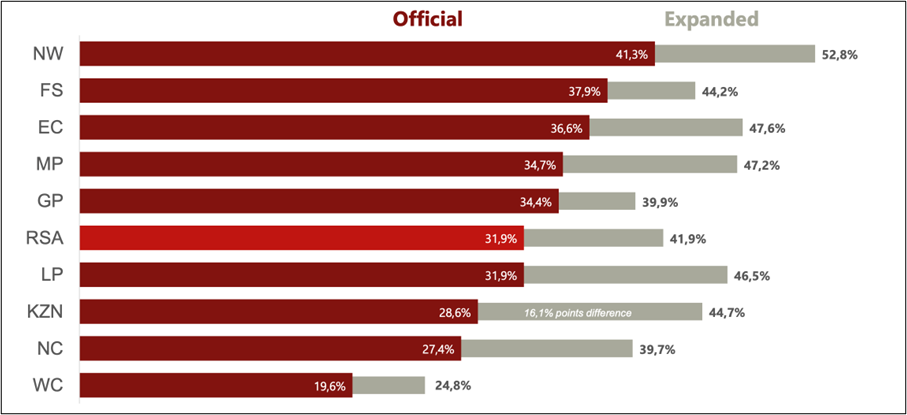
Looking a little deeper and beyond GDP contribution, the province’s official unemployment rate has steadily risen from 23.5% in 2013 to 34.8% in 2023, in comparison to the economically diverse provinces of Gauteng, KwaZulu-Natal, and the Western Cape, which reported the highest increase in employment. The 2024 quarterly report (Figure 3) confirms this trend, reporting that the North West Province recorded South Africa’s highest official and expanded unemployment rates at 41.3% and 52.3%, respectively (Statistics South Africa, 2025).
Figure 3: South Africa’s provincial unemployment rates (%), 2024 Q4
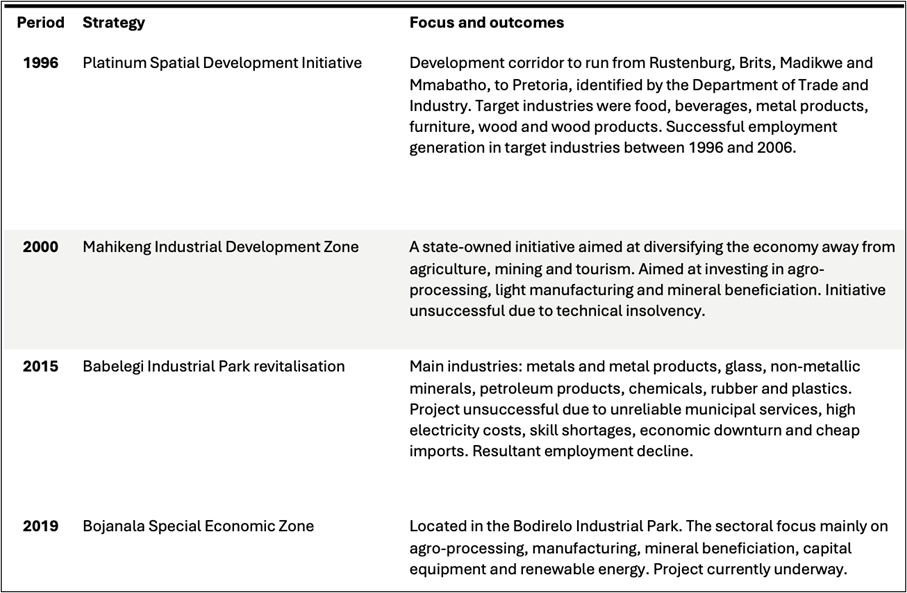
Therefore, an economic diversification strategy is essential to addressing this challenge, and I suggest previously introduced diversification strategies (See Table 2) that could lead to the economic and social development of the provinces.
Table 2: Economic diversification strategies previously introduced
Offline Reference:
- Development Bank of Southern Africa. (2000). South Africa: Inter-provincial comparative report. Development Bank of Southern Africa.
Connect with the Author

Palesa Mpofu is a developing researcher at the University of South Africa’s Department of Economics. Her area of specialisation is economic development, with specific interests in economic diversification and structural transformation, urban and regional economics, gender and development, climate change, and food insecurity. She is also a member of the Regional Studies Association.