Cities amid Demographic and Migration Transformations:
Reflections on Participation in the RSA Annual Conference 2026
Solomiia Tkach, PhD, Guest Researcher, the Institute for Urban and Regional Research of the Austrian Academy of Sciences, Senior Research Fellow, the Dolishniy Institute of Regional Research of the National Academy of Sciences of Ukraine
Demographic shifts, labour-market transformations, and migration are structural forces shaping cities and regions. Population ageing, labour shortages, forced displacement, and uneven population distribution are reshaping housing demand, infrastructure pressures, and local labour markets. Migration should therefore be understood not only as a demographic phenomenon but also as a driver of urban spatial transformation and a test of institutional resilience.
Since 2022, European cities have become important testing grounds for assessing how municipal governance, housing policy, and labour-market institutions respond to rapid demographic change. Within this context, I presented my research at the RSA Annual Conference 2026, held on 15–18 June 2026 at the School of Business, Economics and Law, University of Gothenburg. The study is conducted within the JESH programme at the Institute for Urban and Regional Research of the Austrian Academy of Sciences.
My presentation formed part of the thematic session “Demography, Labour Markets, and Migration 4: Responding to Shocks.” The paper, entitled “Transforming European Cities: Spatial Practices of Ukrainian Refugees as Agents of Urban Change,” introduced an approach that considers forcibly displaced Ukrainians not merely as recipients of integration policies but as active agents in the spatial transformation of receiving cities. Drawing on the contrasting urban systems of Vienna and Prague, the presentation demonstrated how the interaction between housing accessibility, spatial settlement patterns, pathways into employment, and everyday practices of urban space use contributes to the formation of new social and institutional networks at both neighbourhood and city levels.
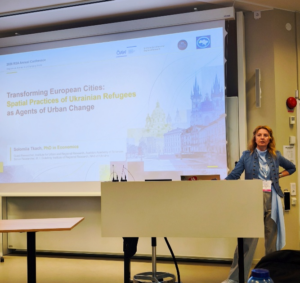
The discussion following the presentation provided an opportunity to compare the displacement of Ukrainians with other forms of demographic and labour-market shocks experienced across Europe. Participants’ comments focused primarily on the comparative institutional capacities of cities in different national contexts and on the role of housing policy as either a barrier to or a catalyst for migrants’ access to the labour market.
The RSA Annual Conference is one of the leading international platforms for interdisciplinary dialogue among scholars working in regional development, economic geography, urban studies, demography, migration, and public policy. This year’s conference theme, “Regions as Arenas in a Changing World,” accurately reflected the current orientation of regional research. Cities and regions are increasingly understood not as passive recipients of external pressures but as arenas in which geopolitical shifts, socio-economic inequalities, climate risks, and new forms of mobility intersect and take concrete spatial and institutional forms.
As an RSA member, participation in the conference was particularly valuable to me. It enabled me both to test my research findings through discussion with an international academic audience and to meet in person colleagues whom I had previously encountered at other Association events, while also expanding my wider network of professional contacts.
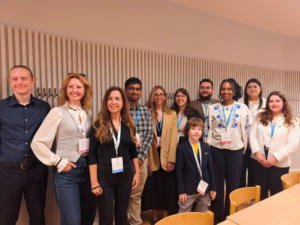
I was also honoured to receive an RSA Annual Conference Bursary 2026, which supported my participation and confirmed the international scholarly relevance of Ukrainian migration as a factor in contemporary urban and regional transformation. For Ukrainian researchers, such programmes are an important means of presenting research, joining international networks, and developing long-term partnerships.
The programme included more than 700 presentations across fifteen thematic strands, alongside plenary lectures, special sessions, professional-development workshops, and networking activities. An equally important component of my participation was attendance at the plenary sessions, which established the broader theoretical framework of the conference. The opening plenary, “Regions as Arenas in a Changing World: Rethinking Spatial Theories,” raised questions about the extent to which classical spatial theories remain applicable to contemporary challenges. The “Area Development and Policy Annual Lecture: An Integrated Place-based Approach to Societal Challenges” developed this discussion by emphasising the importance of integrated, place-based policy approaches.
The plenary sessions established the broader theoretical framework of the conference. “Regions as Arenas in a Changing World: Rethinking Spatial Theories” reconsidered the relevance of classical spatial theories, while the “Area Development and Policy Annual Lecture: An Integrated Place-based Approach to Societal Challenges” focused on integrated place-based policy. “The Long Shadows of History – Can Regions Escape their Past?” addressed path dependency, and the “Regional Studies Annual Lecture: Broadening Regional Horizons” outlined new directions for Regional Studies under conditions of uncertainty.
Among the parallel and special sessions, I was particularly interested in “Regional Planning and Governance,” “Agglomeration, Clusters, and Externalities 2: Regional Anchors, Regional Footprints,” the panel discussion “EU Cities Agenda,” and “User Needs and Governance Scenarios for Participatory Research Infrastructures: A Regional and Policy Perspective.” These sessions addressed multilevel governance, spatial interdependencies and clusters, urban competitiveness and inclusiveness, housing affordability, and the governance of research infrastructures.
The discussion of the “EU Cities Agenda” was particularly revealing. It confirmed that even within the European Union, the coordination of urban policies remains fragmented. This issue is also highly relevant to the Ukrainian context of post-war reconstruction, the modernisation of urban governance, and the alignment of urban policy with regional and national policy frameworks. I also participated in the informal “Social Meet Up,” which created opportunities for direct professional exchange with colleagues beyond the formal setting of conference sessions.
Overall, the conference provided substantive feedback on my research, helped position it within current theoretical and applied debates, and expanded my international network. It also offered a comprehensive overview of major trends in global regional development, including demographic and migration change, labour-market restructuring, territorial inequalities, and new models of urban and regional governance.
I would like to express my gratitude to the organisers of the RSA Annual Conference 2026 for creating a stimulating platform for the international exchange of knowledge in regional and urban studies and for fostering an open and collegial professional atmosphere. I am also particularly grateful to the Institute for Urban and Regional Research of the Austrian Academy of Sciences for supporting and facilitating the presentation of my research findings at a high-level international academic event.
About the author
Solomiia Tkach is a researcher in the field of urban and regional development whose expertise combines economic, urban, and migration dimensions with the spatial analysis of territorial transformations. In 2015, she defended her PhD thesis at the Institute of Regional Research of the National Academy of Sciences of Ukraine on the topic “Mechanisms for Managing Investment Activity Risks in the Region.” She serves as a Senior Research Fellow at the Department of Spatial Development and as Head of the Department of International Cooperation and Project Activities at the M. I. Dolishniy Institute of Regional Research of the National Academy of Sciences of Ukraine.
She is the author and co-author of more than 100 scientific publications in the fields of urban and regional development, spatial transformation, and territorial resilience. She has completed research stays at the Institute for Urban and Regional Research of the Austrian Academy of Science, Salzburg University of Applied Sciences and the Institute of Spatial Planning at TU Wien. Her current research examines the spatial integration of forcibly displaced Ukrainians across different urban systems and explores the spatial and structural imperatives shaping urban development under conditions of polycrisis.