New debates on regional studies call for opening up conversations around different perspectives and methods for understanding territories. The 2026 Student and Early Career Conference, “Emergent Directions in Regional Research,” held at Cardiff University, created exactly this kind of space, bringing together young scholars eager to deepen their knowledge of regional science across disciplines and approaches.
The conference covered a wide range of themes within the regional field, including climate change and socio-environmental studies, territorial governance, “left behind” places, urban structure and development, regional modelling and policy, and economic and trade perspectives on regional development. This is far from an exhaustive list of everything discussed, but it gives a clear sense of where the field’s energy is concentrated: on resilience, inequality, and how regions adapt — or struggle to adapt — to overlapping pressures from climate change, geopolitical instability, and technological change.
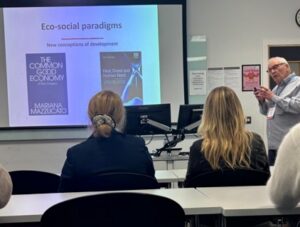
One of the most insightful elements of the conference was the space it created for those engaged in shaping new research agendas in regional studies — especially early-career researchers seeking new perspectives to advance their agendas and build connections to other latitudes and colleagues from different contexts. In this sense, the conference opened opportunities to explore the themes and methodologies being used among academic peers, and to work through shared difficulties in conducting research.
The keynote “What are the Big Questions in Regional Research?” opened the discussion on regional studies and its evolving impact on academic thinking. Although there is no single formula for answering this question, but rather several possible paths, the talk encouraged us as regional researchers to bring innovation and creativity into reconfiguring our own work through dialogue across disciplines and methods.
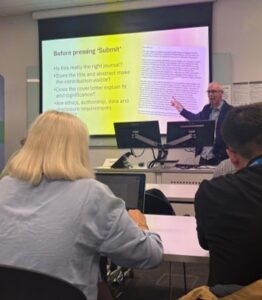
The roundtable “Where is Regional Studies Going?” was very helpful in bringing together the different debates and main research topics that have shaped regional studies since the 1990s. Since its center was based on an economic and quantitative perspective, moving toward mixed methods, contested cartographies, and new discourses. Along the way, regional studies have opened new discussions about emerging expressions of power and how they redefine regions — the tensions and effects of this redefinition were some of the aspects that arose during this session.
In one of the parallel sessions, I presented my own paper, “Sustainability Narratives and Uneven Water Territories in Greater Cairo: A Critical Reading since 1990,” which traces how different actors and networks have territorialized Greater Cairo through uneven expressions of territory — shaped, in large part, by the climate, environmental, and sustainability policies and narratives now circulating across Global South megacities. It was a chance to test those arguments against a room thinking about “left behind” places and regional governance from very different geographic starting points, and the discussion that followed pushed the comparative angle further than I’d expected.
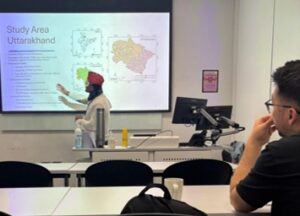
In terms of developing new networks and expanding access to new funding and academic collaborations, the conference offered an excellent space to inspire and give momentum to new projects opportunities. The diverse experiences shared by researchers were not only inspiring, but also exposed the audience to a wide range of projects and research areas for early-career researchers to explore.
In this sense, two days in Cardiff showed that regional studies, despite its methodological diversity, is still a small enough field for a coffee break to turn into a future collaboration. For early-career researchers facing the same uncertainty named in the conference’s own theme — geopolitical tension, climate pressure, and economic instability — this kind of connection is not simply a side benefit of attending, but one of the main reasons to be there.
Finally, I would like to express my gratitude to Cardiff University Business School and Cardiff Metropolitan University for hosting and driving this initiative together with RSA — and for introducing us to traditional Welsh cakes along the way. For anyone at a similar stage in their research career, the RSA’s Student and Early Career Network is worth exploring further — it’s exactly the kind of space this conference pointed toward.

Laila P. Estefan-Fuentes is a postdoctoral fellow at the University Program of Studies on Asia, Africa, and Oceania (PUEAAO-UNAM) and an instructor in the Graduate Program in Geography at UNAM. Her research interests focus on three primary areas: 1) urban-regional geography and its socio-environmental impacts in the Global South, with a particular emphasis on water and air quality; 2) historical-territorial processes that mediate socio-environmental dynamics and their regional climate-environmental impacts; and 3) science-technology-society (STS) interactions aimed at applying climate and territorial policies at the urban-regional scale in developing economies.
Find out more https://pueaa.unam.mx/en/personas/Laila-Patricia-Fuentes