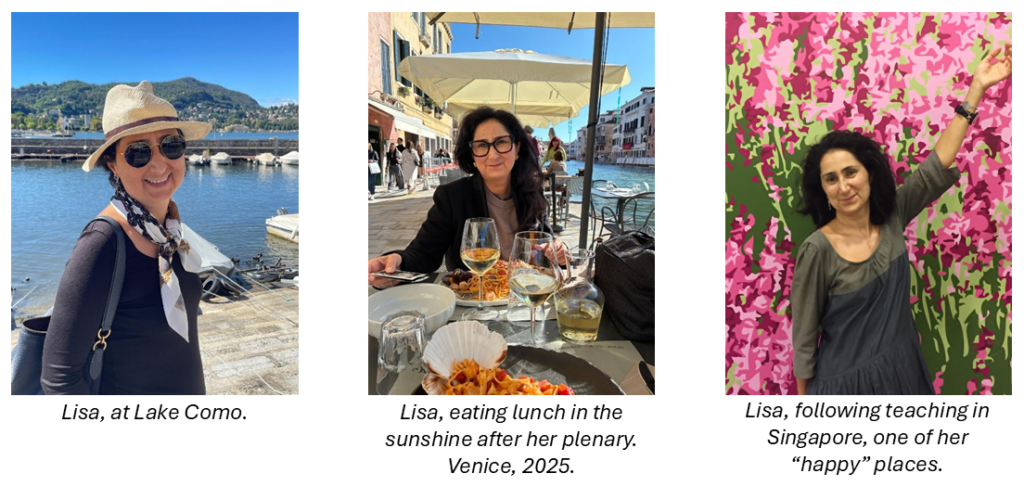
Lisa De Propris was born in 1967 and grew up in Bologna, in the Emilia-Romagna region of Italy. She studied for her first degree in Political Science and Political Economy at the University of Bologna graduating in 1992. Inspired by her early mentor Patrizio Bianchi, Lisa continued her studies, moving to the UK to undertake a Masters’ degree in the Economics of the EEC at the University of Exeter.
Lisa quickly adjusted to and began to enjoy British life, despite its cooler and wetter climate, different food and peculiar quirks, and soon afterwards she embarked on a PhD in Economics at the University of Birmingham Business School, on ‘Flexibility and Innovation in District-Type Clusters’. It was the beginning of a long, successful and highly productive association with the University that continued for the rest of her life. Lisa’s first academic appointment (at Birmingham) was as a Research Fellow on an EU-funded project developing the West Midlands’ first Regional Innovation Strategy, which had a lasting impact on the region.
Her career at Birmingham subsequently blossomed. She was appointed to a lectureship in 1998 and rose through the ranks, at a time when it was especially difficult for women to climb the academic career ladder. During her career, Lisa was hugely successful in securing and overseeing numerous major EU and other research funded projects and coordinated the highly impactful Horizon ‘MAKERS’ project with colleagues from across the EU, USA and Singapore.
Lisa’s research largely focused upon local production systems, innovation systems, industrial strategy, creative industries, technological change and Industry 4.0, and she consistently published her work in the world’s leading scholarly journals. In so doing, she soon earned the respect and admiration of esteemed international peers.
Lisa was also a highly regarded and inspirational lecturer and supervisor. She greatly enjoyed teaching at Birmingham, on university partner courses in Singapore, and at international summer schools especially those held in Ferrara and Cervia, both close to her childhood home. Many of Lisa’s PhD students have gone onto very successful academic careers, both in the UK and internationally. Lisa was promoted to a personal chair in 2015.
Despite her long association with Birmingham, Lisa never forgot her childhood roots and indeed, much of her research was inspired by the ongoing success of – and challenges to – the ‘Marshallian’ industrial districts that are still to be found in and around Emilia Romagna. In 2009, Lisa co-edited (with Giacomo Becattini and Marco Bellandi) A Handbook of Industrial Districts (Edward Elgar), an 863-page collection of chapters, and which has become the modern seminal work on the topic. This book helped to establish Lisa as one of the world’s foremost experts on industrial districts.
Much of Lisa’s work had, by its nature, regional policy implications. Lisa’s interest in policy was driven by a passion to explore how place-based initiatives might alleviate and possibly address decline, especially in lagging and post-industrial regions. She was often invited to speak and advise on regional industrial and innovation policy at regional, national and international levels. Audiences included the UK Parliament, the European Commission, the European Committee of the Regions and the OECD, amongst others. She also acted as an evaluator and advisor to VINNOVA, the Swedish Innovation Agency for many years.
Between (2016 and 2021), Lisa was the Policy Debates editor at Regional Studies, helping to establish this as the ‘go to’ section of the journal for scholars and policymakers interested in regional policy issues. Since 2021, Lisa has served as an editor of the main section of Regional Studies. Lisa also acted as a Guest Editor for numerous Special Issues with other leading journals. At the time of her sad passing, she was co-editing a Special Issue of the International Journal of Operations and Production Management (IJPOM) on supply chains and industrial strategy.
Throughout her career, Lisa also played leading roles in academic networks, initially with the European Union Network for Industrial Policy (EUNIP), and then with the Regional Studies Association, which she saw very much as an intellectual home. Last October, she gave an inspiring plenary at the Regional Innovation Polices Conference in Venice. This year’s conference is being organised in Birmingham, and Lisa would have played a key role.
An adopted Anglophile, outside academia, Lisa loved cooking Italian (and later Thai) food, fashion (her late mother was an accomplished fashion designer), socialising and travel, especially holidays with her family in Italy and in Cornwall.
Her family and friends will treasure her great zest for life, terrific sense of fun, and kindness to others. She is survived by her husband David, son Mikey, her sister Sylvia, and their crazy labradoodle Coco.
Our thoughts are with the family in this incredibly difficult time, and we send our deepest sympathies.