The 2026 Annual Conference of the Regional Studies Association (RSA) China Division was successfully held at Wuhan Little Turtle Hill Financial and Cultural Park, Wuhan, on 21 March 2026. The conference was organised by the RSA China Division and hosted by the School of Economics and Management, Wuhan University. More than 200 scholars from leading universities and research institutes in China and abroad, including Peking University, Fudan University, Zhejiang University, Tongji University, Nankai University, Beijing Normal University, and the Institute of Geographic Sciences and Natural Resources Research, Chinese Academy of Sciences, gathered in Wuhan for this academic event.
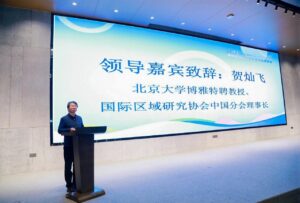
The theme of the conference was “Regional Coordinated Development and Regional Resilience in the New Era.” Focusing on frontier issues such as new theories and methods of regional coordinated development, high-quality development empowered by the “new three transformations,” urban agglomeration and metropolitan development, regional green and low-carbon development, territorial spatial governance, regional innovation, regional industrial division of labour, urban-rural integration, and population mobility and high-quality development, the conference featured multiple invited plenary lectures and 11 parallel sessions spanning geography, economics, management, and urban and rural planning. The conference opened on the morning of 21 March. Xu Dongxing, Assistant President and Chairman of the Trade Union of Wuhan University, and Professor Canfei He, Chair of the RSA China Division, delivered the welcome remarks. The opening ceremony was chaired by Wang Liping, Party Secretary of the School of Economics and Management, Wuhan University.
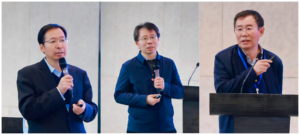
After the opening ceremony, the conference moved into the invited plenary lecture session. The first stage was chaired by Professor Luozhi Luo, Vice Dean of the School of Economics and Management, Wuhan University. The speakers and their presentation topics were as follows:
Chuanglin Fang: Classification Innovation and Governance of Modern Urban Agglomerations
Canfei He: China’s Regional Economic Resilience
Fengjun Jin: Directions and Priorities of China’s Regional Linkage Development during the 15th Five-Year Plan Period
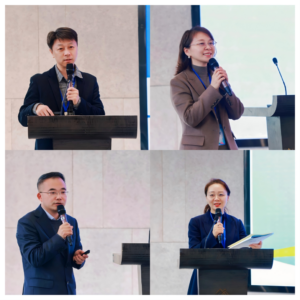
The second stage of the plenary lecture session was chaired by Professor Xuesong Li, Director of the Department of Economics, School of Economics and Management, Wuhan University. The speakers and their presentation topics were as follows:
Shuai Shao: The Hidden Pollution Transfer Effects of Regional Environmental Regulation Policies
Mi Zhou: The Logic and Pathways through Which Artificial Intelligence Reshapes the Pattern of Regional Coordinated Development
Zhigang Li: The New Transformation of Regional and Urban Spatial Governance in China
Zhi Luo: Evaluating the Effects of Unified Water Resource Allocation Policy in the Yellow River Basin
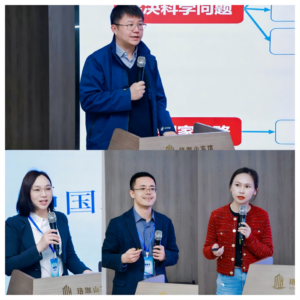
On the afternoon of 21 March, the conference moved into parallel sessions. Topics included:
- High-quality regional development under global transformation
- Innovation networks and high-quality regional development
- Energy transition practices and the Green Silk Road
- Watershed ecological governance and regional green and low-carbon development
- Regional economic resilience and policy innovation under overlapping crises
- Collaborative evolution of regional innovation networks and innovation governance
- Cross-regional coordinated layout of digital infrastructure under the energy transition
- Urban and regional environmental issues
- Green and low-carbon development in less-developed regions
- Factor and product flows in the context of a unified national market
- Climate leadership and regional sustainable development
Across these eleven sessions, scholars actively shared their latest research findings. The discussions were lively and thought-provoking, fully demonstrating the depth of academic exchange and the vitality of scholarly interaction at the conference.
On 22 March, the conference moved into a high-level academic dialogue chaired respectively by Professor Zhouying Song from the Institute of Geographic Sciences and Natural Resources Research, Chinese Academy of Sciences, and Professor Fenghua Pan, Vice Dean of the Faculty of Geographical Science, Beijing Normal University. The discussion focused on digital and intelligent transformation and high-quality regional development, green transition and regional low-carbon development, and shifts in the paradigm of regional studies under the impact of artificial intelligence. The dialogue reflected both the depth of professional reflection and the breadth of interdisciplinary exchange, offering valuable insights for advancing the innovation and development of regional studies in the new era.
The keynote speakers of this session were as follows:
Zhouying Song: The Belt and Road Initiative and Trade Geography
Fenghua Pan: Pathways and Mechanisms for Upgrading from Contract Manufacturer to Global Leading Firm: A Case Study of the Sports Footwear and Apparel Industry in Quanzhou
Chen Wang: Addressing Interregional Inequality: A Chinese Governance Path? Evidence from Zhejiang’s Mountain-Sea Cooperation Model
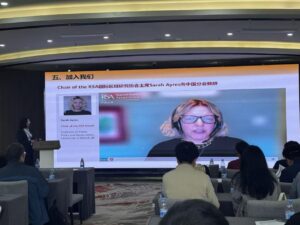
At the closing ceremony, Professor Zhouying Song introduced the development of the RSA China Division, its academic activities, and its support for early-career scholars, and invited more scholars in regional studies to join the association. Sarah Ayres, Chair of the RSA, delivered a video message to congratulate the successful conference. The 2027 Annual Conference will be hosted by the School of Management, Xi’an University of Architecture and Technology, and Professor Lan Feng introduced the next conference.
Focusing closely on the core theme of “Regional Coordinated Development and Regional Resilience in the New Era,” the conference brought together multidisciplinary perspectives and multi-level reflections. It not only showcased frontier explorations in theory and methodology by scholars from China and abroad, but also responded to the practical needs of regional development and spatial governance. The conference provided an important platform for deepening academic exchange and interdisciplinary integration, while injecting new momentum into serving national strategies and regional practice.